We love to discover anything and everything about food. This, often, takes us places. Whether it's to the farm down the road or that fromagerie on Queen Street, we are epitourists!
Thursday morning, I pull the starter out of the fridge and feed it. With half a loaf left in the bread box, it's time to bake again. Mill some rye kernels into flour; mix with 20 g of starter, bread flour and water. Repeat at bedtime.
What is it about sourdough? Challenge. Why settle for downhill when you can telemark! Crazy isn't it but, it's true. It's also a healthy choice. Good for the microbiome and all that jazz. OK, it's also delicious as heck!
Thursday morning starter feed.
Starter feeds and dough prep take place in the laundry room. Since the process stretches over 3 days, I like to keep the mess contained and out of the way.
An old pine hutch holds all the necessary tools: note book, Tartine Bread book, pans, flours, kernels, dough bowls, bannetons, utensils (and a spurtle to name one), flour mill, etc. Oh, I forgot the Brød-Taylor proofer. Since we keep a cool house at 19ºC, it was necessary to invest in this gadget to keep starter, levain and dough happy.
The right tools make the job much easier
Friday morning 8 o'clock finds me mixing my levain. I measured the flour the night before to expedite this step... after all morning coffee awaits. After 5 hours in the proofer, I start on the dough mix. I quickly realize that I have WAY too much levain. What to do? What to do? What the hoo let's make more bread. You know that feeling you get when you're about to step off the ledge. Well, I experienced it and guess what? I stepped off the ledge and found myself mixing, stretching and folding more dough than I cared to shake a spurtle at! It took sourdough bread making to an Olympic level. Arms of steel!
20 kg of wet dough!
Bulk fermentation comes to an end at 17.00.
Time to divide, shape and conquer.
Hero the dog is surprised to see me up at 7 bells on a Saturday morning. I turn on the oven and start scoring. I decide to keep it simple before coffee. Après café, I ramp things up with Anna and her lovely scoring tutorial.
I give it a whirl to discover that the scoring process is very meditative and pleasant.
Sourdough has a life of its own. Truly. You can try your best. But in the end, the dough has the final say. Needless to say, I was very eager to see the end result.
Although the bread did burst out of the score lines...
...it is still visually appealing!
So, there you have it. That is how I came to bake 10 loaves of Tartine's country rye sourdough bread on Saturday morning.
With
Covid-19 at large, Epitourists were all staying put: Safe in our homes —
Laura on Wolfe Island, Caroline in the Durham Forest, Diane and I in
Toronto. Yes, we were all social distancing, in self isolation, but we
were not about to cancel our March Epitourist lunch.
There
was no getting around it. If we wanted to eat and greet, we had to get
over ourselves and our antipathy to seeing ourselves and being seen on
video. It was time to dial up a video conference call. Of course, we
couldn’t share the taste or smell of the dishes we each prepared in our
own kitchens but we could see them and enjoy our own creations in
virtual companionship.
This was more a social call than
a culinary happening. The idea was to cook from ingredients that are
pantry staples in most people’s kitchens. No special trips to the store
required.
Caroline
Opa!
An hour before our virtual lunch I decided on Greek Egg-Lemon Chicken Soup, or Avgolemono, to
use up the chicken thighs from the freezer. This five ingredient soup
is comforting and delicious. The eggs act as thickening agents. The
lemon zest and juice bring a delightful zing of acidity to the savoury
chicken broth.
It
was nice to have lunch with my epicurean friends. Life as we know it
today has put a stop to the touristic aspect of our group. Trips are
being cancelled and we give going out the door a second thought.
Kaarina
Pasta, pesto with potatoes and green beans.
The
great late Marcella Hazan who taught the world to cook Italian declared
in her Essentials of Classic Italian Cooking: “When all its components
are right, there is no single dish more delicious in the entire Italian
pasta repertory.” This was not the case with my Pasta and Pesto with
Potatoes and Green Beans. Unfortunately, I forgot Marcella’s cardinal
rule. Seasonal. Perhaps if my potatoes really had been new small
potatoes and the green beans fresh from the garden or a local farm
market ... Instead the potatoes were pantry staples at the end of
winter, and the green beans were not even green beans but frozen
edamame, and the pesto was the last of the pesto I made from my garden
basil and froze in September. Well, you can’t freeze pesto for six
months and expect it to taste like summer.
Diane
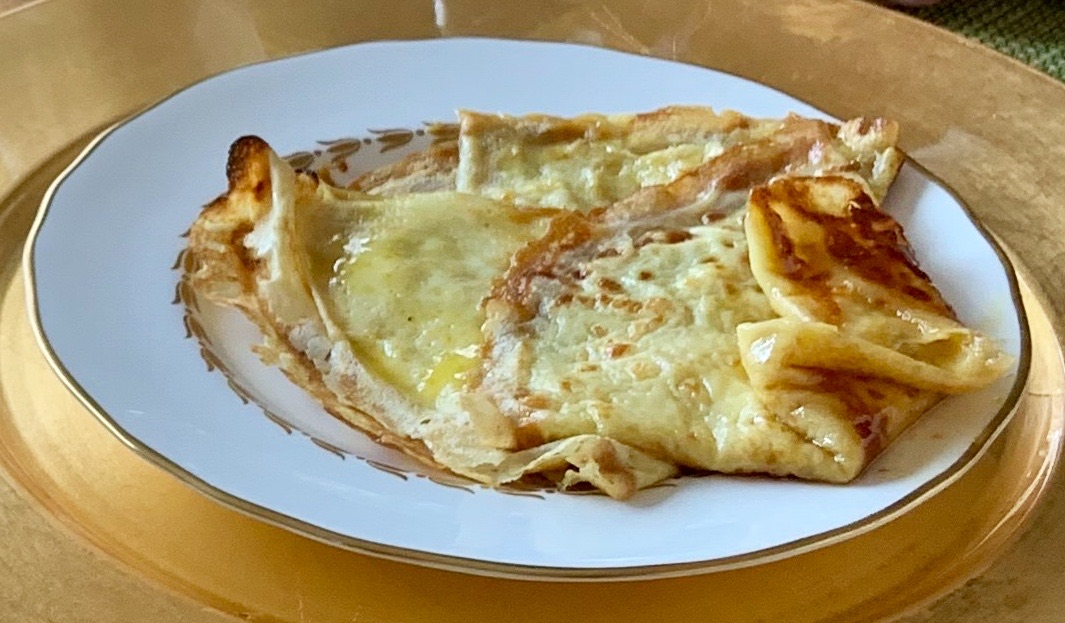
Crêpes Suzette!
Personally
I have found extra time to tinker in the kitchen and spend a bit more
time experimenting. Ruth Reichel started my quest for perfect crêpes
with her recipe for German Apple Pancakes, making them seem deceptively
simple in her book, Save Me the Plums. On my first attempt they were
certainly not thin enough to be stacked three high, layered with filling
and rolled. Try again. The secret to thin crêpes seems to be to
refrigerate the batter and let it rest. I turned to the more classic crêpes Suzettefor
the Epitourist lunch, having simple ingredients at hand. I have to say,
I did like flaming the crêpes with Grand Marnier, with the liqueur
adding a taste of torched caramel. Delicious! Paired with a glass of the
same liqueur.
We've
all seen the internet memes showing the ten pound gain "before" and
"after" self isolation. All this time on our hands and the fridge so
nearby... I will have to seek out more recipes with a bit less butter,
but why deny the occasional extravagance?
Laura
Having a well-stocked pantry is a regular fact of life when you live 20
minutes away from a 20-minute ferry ride to the closest grocery store.
There’s never any popping out to pick up an ingredient you don’t have on
hand. We are fortunate to have neighbours on the island who provide us
with eggs and beautiful grass-fed beef and pork. During he summer I have
land to grow vegetables. But at the moment I have my son and his
girlfriend, who is vegan, living with me. The fresh summer veggies are
not around yet and I don’t always feel like preparing meat and non-meat
lunches. So I had to get creative.
Hhmm... cauliflower bolognese!
There was a cauliflower lurking in my produce drawer,
and I had most of the other ingredients on hand to make a cauliflower bolognese.
I used olive oil instead of butter, and I kept the parmesan out of
Mira’s portion, replacing it with a bit of nutritional yeast, which is a
good umami substitute for cheese. I didn’t have rigatoni, so I
substituted gemelli pasta. I didn’t have fresh parsley, so I snipped a
few of my kale sprouts that I have growing in my little indoor
microgreen garden.
My turn to choose the theme! Since I’m always on the look out for
healthy alternatives to meat-based meals, I picked Vegetarian.
We are packing more into our Epitourist get-togethers. Our lunch was
preceded by a day of foodie excursions to Aloette and Eataly. Sunday’s courses
felt relaxed and restorative in contrast to the previous day’s pace.
When Diet for a Small Planet was published in 1971 it was a radical book
that chronicled the harmful environmental impacts of meat production and its
compounding effects on food distribution across the globe. Today the trend
toward plant-based diets is also supported by people with concerns for the
ethical treatment of animals and those who want to improve their own personal
health. Change often takes time. When Canada revamped the Food Guide in 2019,
the government still faced a strong lobby from meat and dairy interests
threatened by the move away from animal proteins.
Today there are so many cookbooks and advocates for plant-based meals
it’s hard to choose a definitive source: Michael Pollan, Jamie Oliver, Dr.
Michael Greger, Angela Liddon… the list continues to grow.
Our own Epitourist menu was a wonderful mix of colour, comfort,
simplicity and elegance. Didn’t miss the meat whatsoever!
Menu
Starter | Laura
Muhammara roasted red pepper dip with
focaccia and goat chevre
paired with Prosecco
Salad Course | Kaarina
Five-Spice Peach and Raspberry Salad
paired with Riesling
Main | Diane
Russian Carrot Pie
paired with Golden Milk
Main | Caro
Steamed celeriac and mushroom pudding
with Madeira sauce
paired with Madeira
Dessert | Laura
Lemon Pudding Cake
Digestif | Diane
Pousse-Café / selection of
liqueurs
Muhammara roasted
red pepper dip ❦ Laura
Syrian Muhammara Dip
I was last to announce what I would make for our vegetarian feast. As
often happens at these long lunches, we get so enthusiastic about what we want
to make that we end up with way too much food. The others had already proposed
hearty courses, so I thought an appetizer dip would be fitting. But I didn’t
want to make a run-of-the mill hummus or cream-cheese based dip. Ottolenghi
never fails to offer interesting flavour combinations. I chose his Muhammara/roasted
red pepper dip. Muhammara dip comes from Syrian cuisine. I loved the idea
of combining red peppers with pomegranate molasses, walnuts, and aleppo pepper.
Diane has gas burners, so charring the peppers was easy on her stovetop. The
resulting dip was spectacular. We served it with some foccacia and flatbread
crackers purchased during our Eataly outing.
Five-Spice Peach
and Raspberry Salad ❦ Kaarina
A true chef d'œuvre!
Thinking outside the pot, I looked for fresh raw colour and bite to add
to our menu. I didn’t need to look far. If anyone knows how to pull together a
great vegetarian spread, it’s Ottolenghi and I had been reading and cooking
from both Jerusalem and Simple this winter. I settled on Five-Spice Peach
and Raspberry Salad from Simple:
In a
large bowl, whisk together
1-1/2 tbsp. cider vinegar
1 tsp maple syrup
1/4 tsp Chinese 5-spice powder
1 tbsp olive oil
1 shallot, thinly sliced (1/4 cup)
1/4 tsp salt
Just before serving, add
3-1/2 oz raspberries
3 firm peaches, not too ripe, cut into
1/4 inch wedges
2 cups watercress
2 cups radicchio, cut into 3/4 inch
slices.
Toss and serve.
What made this salad visually extra spectacular was the rosy radicchio
we found in the produce section at Eataly, which was on our Epitourist winter
tour of downtown Toronto the day before. The rosy leaves were so beautiful I
couldn’t bring myself to tear them, so I tucked them in whole amongst the
watercres and peaches. This loose leaf radicchio is less bitter than the
tightly packed leaves of a standard radicchio but the watercress along with the
shallot had enough bite to balance the sweetness of the fruit.
Wine
can be a challenge with salads. What to pair? The peach? The bitter
greens? Or the sherry vinegar dressing? Cave Springs off dry Riesling
did the job brilliantly..
Russian Carrot Pie ❦ Diane
A very creative pairing!
Oh how I loved Molly Katzen’s Enchanted Broccoli Forest cookbook! Hand
written, with simple instructions and whimsical illustrations, it inspired me
to make some of my first vegetarian meals. Published in 1974, it may be dated
when compared with some of today’s titles, but it still brings a smile to my
face. I thought the Epitourists would enjoy Russian Carrot Pie, and they did,
although next time, I would cut back a bit on the dill.
Delightful!
For this course, instead of pairing with wine I chose a concoction of
coconut milk, oat milk, turmeric, ginger and cinnamon. The decision to serve
Golden Milk was made on colour alone, but happily the taste nicely complemented
the flavours in the pie.
Steamed celeriac and mushroom pudding with Madeira sauce
❦ Caroline
Savoury Pudding!
I turned to Dani Valent’s In the Mix
— Great Thermomix Recipes for Diane’s vegetarian theme. Australian based cook,
Valent sourced recipes from chefs and bloggers far and wide to put together
this beautiful cookbook. Steamed Celeriac and Mushroom Puddings, is British
chef Madalene Bonvini-Hamel’s creation. Completely vegetarian, it is elegant,
comforting and deliciously savoury. Filling 50 g butter 70 g mushrooms salt and pepper to
taste 20 g flour 1/2 onion, peeled
and diced 1 clove of garlic 1/2 stalk of
celery, cut into 1 cm dice 1 small carrot,
peeled and coarsely grated 250 g celeriac cut
into 1 cm dice 30 g Madeira 150 g vegetable
stock 1 tbs chopped
parsley 1 tbs chopped chives Melt 25 g butter in
a frying pan. Cook mushrooms with a little salt and pepper for 8 minutes at
medium-high temperature. Set aside. Melt remaining butter, add onion, garlic,
celery, carrot, celeriac and flour. Cook 10 minutes on medium-high until nicely
caramelized. Add the Madeira. Cook for 4 minutes. Add the stock and cook on
medium heat to reduce for 5 minutes. Return the mushrooms. Stir in parsley and
chives. Adjust seasoning. Allow to cool on a cookie sheet. Pastry 300 g flour 15 g baking powder 150 g frozen butter salt and pepper to
taste 100 g chilled water Mix flour, baking
powder, butter, salt and pepper. Add the chilled water. Gently knead. Lightly
oil 6 ramekins. On a slightly floured surface, roll the pastry to about 4 mm
thick. Line the ramekins with the pastry. Spoon the cooled celeriac filling
into each ramekin, filling it to the top, dampen pastry rim with cold water and
seal each pudding with a pastry lid. Make a team hole in the centre of the lid.
Pour 1 litre of water into a pot. Set steaming basket in. Place the pudding
ramekins on basket. Cook for 60 minutes on medium-high. Make sure that there’s
sufficient water at all times. Keep a kettle of boiling water handy to top up. Madeira Sauce 50 g dried mushrooms 30 g olive oil 1 sprig of thyme,
leaves only 1 bay leaf 1 clove garlic 1 shallot 100 g madeira 500 g vegetable
stock 100 g 35% cream 50 g butter Pulverize the dried
mushroom in a food processor. Add the olive oil, thyme, garlic and onion and
chop. Transfer the mixture to a frying pan. Add bay leaf and cook on
medium-high for 5 minutes. Add the Madeira and cook for 3 minutes. Add
vegetable stock and continue to cook until stock has reduced by half. Strain
the sauce through a fine sieve. Discard solids. Pour sauce into saucepan along
with cream. Heat for 3 minute until it just begins to boil. Taste and adjust
seasoning. Before serving, add the butter and whisk.
Lemon Souffle Pudding ❦ Laura
Because Ican never resist making something as a sweet end to the meal, I
chose to make a simple lemon souffle pudding. This is an old family recipe from
the mother of Jason, my neighbour on Wolfe Island. He always makes it for
impromptu neighbourhood potluck get togethers.
Digestif ❦ Diane
Lovely colours of a pousse-café
I came across Pousse-caféwhen I was searching for a digestif
to finish our meal. Literally "coffee-pusher" in French, it is an
alcoholic beverage consumed after the coffee course. Pousse-caféhas now evolved
to mean a layered drink composed of different liqueurs.
I thought this would be a fun twist and an appropriate reminder that
although people sometimes equate vegetarian with healthy and virtuous, it’s not
always the case.
Besides, I have a cupboard full of different liqueurs to experiment. The
heaviest liqueur is poured first on the bottom, and so on. We had the most
success with a trio of grenadine, chartreuse and then Cointreau. Use a bar
spoon and steady hand to pour the liqueur. Choose liqueurs that are actually
palatable if you intend to drink your creation.
A
field trip. Of course we wanted to go to Aloette! Their website promises “a refined take on bistro fare paired with sophisticated and affable hospitality.” Caroline, Kaarina, Laura and I had been looking forward to this lunch for quite some time.The experience delivered.
Aloette is currently rated number 35 on
Canada’s 100 best restaurants, just down two flights of stairs from Alo,
rated Number 1 at Canada’s
100 Best. Alo can take months for an available opening. Aloette is more
accessible, and although reservations aren’t required, limited bookings are
available for the convenience of guests. When we arrived, all the tables were filled, so it’s a good thing we made reservations.
Considering the calibre
of the food and service, Aloette offers exceptional value.
Housed
in a heritage building, the restaurant design makes the most of its narrow
space, with vaulted ceilings and windows looking onto busy Spadina Avenue. Rich textures and muted colours make for a relaxed ambiance, in contrast
to the frantic pace on the other side of the glass. Laura
noted that it was noticeably easy to hear each other at our table. The
baffled ceiling is a prominent feature in the restaurant that really
cuts down on the noise, which is such an unwelcome part of most Toronto
dining rooms these days.
The
server was well versed in the menu, made informed recommendations, and was able
to answer our questions. We sipped cocktails while waiting for the small plates to arrive. The Cold Snap
was prettily presented in a small coupe glass, a refreshing mix of Seedlip
garden, verjus, sherry vinegar and thai basil.
We
agreed to share small plates. This is the opportunity to sample more
dishes, but with everything tasting so over-the-top delicious, it was
especially hard to exercise restraint.
Everything was so visually stunning with flavours and textures perfectly balanced.
Toast
with whipped roasted yeast butter was served to awake our tastebuds. Caroline
wondered "Who ever dreamed that up? And
where can I find that recipe?"
Perfect roasted yeast butter
Our
first course was roasted squid with side stripe shrimp, 'nduja, potato, and
cerignola olive, which brought murmurs of pleasure.
First course!
Next, beef short rib with
chimichurri, spinach, and onion ring; served with thai salad of peanut,
mango, zucchini, kohlrabi. Kaarina remarked the fresh
crunch of the Thai salad was a
match made in food heaven when paired with the richness of the beef short rib.
We all agreed with Caroline's assessment that the beef short
rib was melt in your mouth, fall apart delicious!
One more course... potato
gnocchi of sweet potato with bacon, sage, chestnut; served with crispy squash
and brown butter hollandaise, sage, and parmesan, with pumpkin seed. Some were
skeptical when the server suggested the pairing, however Kaarina observed the
combination was the smoothest, tastiest comfort food of this 2020 winter.
Caroline felt the gnocchi was light as air and wondered about chemists in the
kitchen.
Gnocchi and squash...hhmm!
We wanted to sample the rest of the menu! Hamachi crudo, glazed pork belly, iceburg wedge, burger and fries, fried chicken...
It was evident there were
strict codes of service when the request to leave the water pitcher on the
table was denied. Instead, servers returned frequently to top up the glasses.
The four of us were split on opinion on this, with 2 annoyed by frequent
interruptions and 2 happy for the extra real estate on the table.
Laura added the
chef, Patrick Kriss, grew up in Scarborough and attended George Brown college.
He spent time working in Michelin-starred restaurants in France and Daniel
Boulud’s eponymous restaurant in New York City. His Toronto restaurants are widely acclaimed, with good reason.
Aloette was definitely a
teaser for what dinner at Alo would be like. One day the Epitourists will have
to check that out!
The Epitourists have occasionally experimented with Middle Eastern
flavours, but we mostly stay within the comfort zone of Western cuisine.
This month we decided to expand to the Far East with a Vietnamese
theme. The fresh flavours and bright colours seemed a fitting antidote
to a rather grey January in Ontario.
For some inspiration, Diane, Kaarina and Caroline visited a Vietnamese restaurant in Toronto. They intended to go to top-rated Pho Hung but it was the week after Christmas, and they were closed. So they ended up at Saigon Lotus, a vegan Vietnamese restaurant.
This month the feast was held at my house on Wolfe
Island. Fortunately there is a really good Asian grocery store in nearby
Kingston, so I was able to find everything I needed for my dishes. I
chose to make fresh spring rolls. There are so many recipes for these
rolls, but the common element is assorted shredded fresh vegetables
wrapped in soft rice paper wrappers. Sometimes shrimp is added, but I
chose to keep them just a colourful assortment of veggies including
green and red cabbage, red pepper. cucumber, green onion, carrot, Thai
basil, cilantro, and mint. The dipping sauce Nuoc Cham, a very simple yet versatile staple of the cuisine.
Springrolls, Braised Tofu and Crème Caramel à la Kim Thuy
I also made Ka Cho, tofu braised in caramel sauce. It sounds strange, but the simple process of caramelizing sugar, adding
water and soy sauce turns tofu into a savoury, nuanced dish.
There aren’t a lot of Vietnamese desserts, but báhn flan, or crème caramel, is popular. It came as an import from France but
has become a staple dessert all over Vietnam. There are so many recipes
available for this dessert. I used the recipe in award-winning fiction
writer Kim Thuy’s Secrets from My Vietnamese Kitchen.
Caroline
Unfamiliar territory... What to make? My quest lead me to Jn Cooking Channel on YouTube. Informative, organized and clear this website proved to be a perfect springboard to Vietnamese food whats and hows.
The idea of making crêpes Vietnamese style or bánh xèo appealed to me because it is somewhat familiar, well the crêpe part is. The batter consists of rice and tapioca flour, coconut cream, turmeric, canola oil and beer. Traditional fillings are pork belly, shrimp and soya beans. A traditional Nước Chấm or fish sauce based dipping sauce gives this dish great zing with its bird's eye chili. The videos I came across never covered the "how to eat" this crispy delight. A quick search brought me to this short clip from Noodlies:
The fun in Asian cuisine is the sampling of many dish. A recent visit to Saigon Lotus, a Toronto Vietnamese restaurant, had me tasting an eggplant dish that wowed me away. Served along side some jasmine rice, this grilled eggplant or Cà tím nướng mỡ hành is sure to delight!
Grilled Eggplant with Jasmine Rice
Kaarina
There was
no red snapper to be had that Thursday morning just as I was heading to
Wolfe Island for the Epitourist’s Vietnamese cook off. My plan was to
deep fry a whole snapper and pile green papaya salad and ginger lime dressing on top for a dramatic presentation a.k.a. Cá Chiên.
The
theatricals had to be scratched and Plan B went into effect. Instead
of snapper I scored superbly fresh Black Sea Bass at Diana’s Seafood on
Lawrence St. E. A firm white fish with delicate flavour from the
northeast Atlantic. No cause for complaint. As the fish
is simply dipped in egg and potato starch and dunked in boiling canola
oil for two minutes, any Vietnamese flavouring needed to come from the
sauce and/or the accompaniments. Green papaya — which is simply a raw
papaya, available along with green mangoes in Asian green grocers, isn’t
exactly flavourful. Enter Nuoc Mam Cham — the workhorse of great
Vietnamese flavours.
Nuoc Mam Cham flavours scores of
Vietnamese dishes. We used it as a dipping sauce for the fresh roll,
with the shrimp and pork filled Vietnamese crepes, as a dressing for the
green papaya salad and a sauce for the deep fried Black Sea Bass.
Black Sea Bass with Green Papaya Salad
Nuoc Mam Cham
In
a pot over medium heat, bring a quarter cup fish sauce, quarter cup
rice vinegar, 2 tbsp sugar and half cup water to just short of boiling.
Set aside to cool. Add 2 cloves of minced garlic, one minced bird's eye chili and 2 tbsp lime juice, and stir to combine. Make a day ahead (or not) and refrigerate for up to two weeks.
Diane
Years ago, when I first arrived in Toronto, there had been such a
glowing review of a Vietnamese restaurant's hot pot, I just had to make a
visit. Delicious broth kept so hot, diners could essentially cook their
own meal at the table by spearing meat and veg and poaching in the
golden liquid. Once cooked to satisfaction, wrapping the tasty bits as
contents inside a lettuce leaf and dressing with a light sauce. After
the wraps are enjoyed, a delicious soup to finish the meal.
One of my favourite Asian markets is closing the end of January so I had to find another. Sunny Supermarket is just a short drive away and had the lemongrass, oyster mushrooms, quail eggs and raw beef. For the broth itself I picked up the best quality beef bones I could find at St. Lawrence market.
I bookmarked an authentic pho recipe, packed up the ingredients, and travelled with Kaarina to Wolfe Island.
Bone broth is so full of goodness — all that collagen is being touted as
better than botox, a cellulite reducer, great for arthritis and healing
for the digestive tract. Three hours in the Instant Pot brought all the
little pearls to the surface.
As the soup was the last course of the night, we were able to make use
of all the other veg that was prepped and still left over: carrots,
cabbage, red and yellow peppers, enoki mushrooms, bean sprouts, fresh
coriander, mint, thai basil.
This is not "your typical cookbook". Colourful charts and whimsical
illustrations (rather than photographs to free the reader from the idea
that there's only one perfect image for every dish!). The hows and whys content truly reflect Samin's energetic and creative self!
Menu
Pasta alla Puttanesca
Salad of Roasted Beet, Preserved Lemon and Tahini-Yogurt
—with Smoked Mackerel
Maiale al Latte with Roasted Squash, Sage and Hazelnut Panzanella
Amalfi Lemon Tart
Theme cocktail: Caesars!
The four elements celebrated!
Kaarina | SALT
Samin's Pasta alla Puttanesca
I settled on Samin’s own recipe for Pasta alla Puttanesca to showcase layering of salt in a dish. This Italian classic features
salt in several guises — anchovies, capers, olives and (optional)
parmigiana — each delicious in small doses. All together, all at once,
they make a big statement. Huge umami delicious, salty statement.
Having spent the last 30 years searching for ways to reduce my salt
intake, drawing Salt as my assignment was a challenge. Yes, of course I
agree that salt is essential in good cooking, the basic seasoning for
pretty much everything. But little goes a long way. I experimented for a
month, following Samin’s directions but never quite got the knack of
it. I found her approach with salt way too heavy handed and will return
to using the salt grinder, shaker and a measuring spoon.
There’s nothing subtle about Pasta alla Puttanesca, so a bold wine is in
order. California’s Seven Deadly Zins was up to the task. A rustic
Primotivo from Puglia would be equally appropriate.
California's Seven Deadly Zins Old Vine Zinfandel!
Caroline | ACID
"Acid is salt's alter ego. While salt enhances flavours, acid balances them."
Roasted beets with preserved lemon and tahini-yogurt from our beloved Ottolenghi's Simple (and he's on my menu two nights this week)! The preserved lemon and tahini-yogurt blanket the roasted beets with layers of acidity. As per the chef's recommendation, I serve this with a smoked mackerel. Wine pairings are Sancerre -- Henri Bourgeois Les Baronnes and a Mailly Exception Blanche Grand Cru Brut Champagne 2007! After all, Christmas is just around the corner. The acid component of the salad pair well with the Sancerre and highlight the wines butteriness. The Champagne takes the smoked mackerel to heaven! Interesting exercise in pairing.
Roasted beets with preserved lemon and tahini-yogurt
Diane
Michael Pollan, one of my favourite food
writers, wrote the introduction to the book Salt, Fat, Acid, Heat, and
revealed Samin gave him some cooking lessons after she attended his
class on food writing. His observations on sauteing an onion: "...there
was an intricate evolution unfolding in that pan as the rectangles of
onion went from crisply acidic to clean and sweet to faintly smokey as
they caramelized and then bittered slightly as they browned. Samin
showed me how half a dozen distinct flavours could be teased from that
humble ingredient, all depending on how you managed principle number
four, heat."
That insight motivated me to buy a copy of Samin's book and choose the element of Heat for the Epitourist feast.
At
the end of every one of her Heat classes, Samin shares a finished
braise with her students. The book dedicates more than a few pages on
classic braises and stews from around the world, however the dish I
ended up preparing was a braise of pork in milk: Maiale al Latte,
as it seemed we were trending to Italian flavours. Slow cooked over two
and a half hours, the aromas wafting from the oven created a wonderful
background to festivities.
Maiale al Latte!
Laura
I really enjoyed
this month’s theme, which diverted from our usual focus on regional
cuisine. All four of us really enjoyed Samin Nostrat’s Netflix series
and wanted to delve more into the themes and recipes.
I was tasked with exploring fat. In her book, Salt, Fat, Acid, Heat Samin
writes, “Fat adds its own unique flavor to a dish, and it can amplify
the other flavors in a recipe. Simply put, fat makes food delicious—and
one of the most important things any cook can learn is how to harness
its magic.” I wanted to explore this idea by detouring from the obvious
meat fat. I chose to make a salad and focus on using butter instead of
oil in the dressing. I wanted to make a hearty salad that would reflect
the season as well as working well as a side dish, so I chose her
Roasted Squash, Sage and Hazelnut Panzanella. Browning the butter adds
another element to the flavour of the fat, and it stands up well to the
bold flavours in the salad. The recipe for the croutons and vinaigrette
is here https://www.cbc.ca/news/canada/ottawa/warm-winter-panzanella-d-is-for-dinner-1.4983972.
You’ll have to borrow or buy the book for the rest of the recipe.
Failing that, just roast squash in the oven, sauté chopped kale in olive
oil with some onion and garlic, toast some chopped hazelnuts and fry
some sage leaves. Then put the salad together using the method in the
link above.
Roasted Squash, Sage and Hazelnut Panzanella
Caroline
As this was a sleepover dinner, dessert was in order. I stick to my assigned element and opt for an Amalfi Lemon Tart from Oliver's Jamie Cooks Italy. The crust calls for 1/3 cup of Greco di Tufo white wine. It is a new wine for us. And as Jamie suggests: "If you're feeling the Italian vibe, a little slice for breakfast with a black coffee is a real treat." And so, the next day for breakfast, a little tart was enjoyed with an expresso and a tasting of the Greco di Tufo.