Sunday, May 16, 2021

Spring Risotto


In the spirit of online cooking classes, and as Covid stubbornly continues to prevent us from gathering in person, we thought it would be fun to plan a menu we could all prepare and cook together in our separate kitchens.

Caroline chose the dish - risotto. Perfetto! Something we could personalize and that would allow for good, stirring conversation.

There are three different types of rice that are most suitable for risotto: carnaroli is known as the 'caviar' of risotto rice (the creamiest and most forgiving to cook with); vialone nano, which is a shorter grain grown in the Veneto region; and arborio, which is the most widely available. 

Risotto is a wonderful meal unto itself and endlessly adaptable to the season. This is definitely a versatile dish with recipes as plentiful as the individual cooks.

On this beautiful sunny spring evening we enjoyed our variations on the theme and imagined the taste of other plates. Hopefully, soon, we will be able to share a lunch in person.

Caroline 

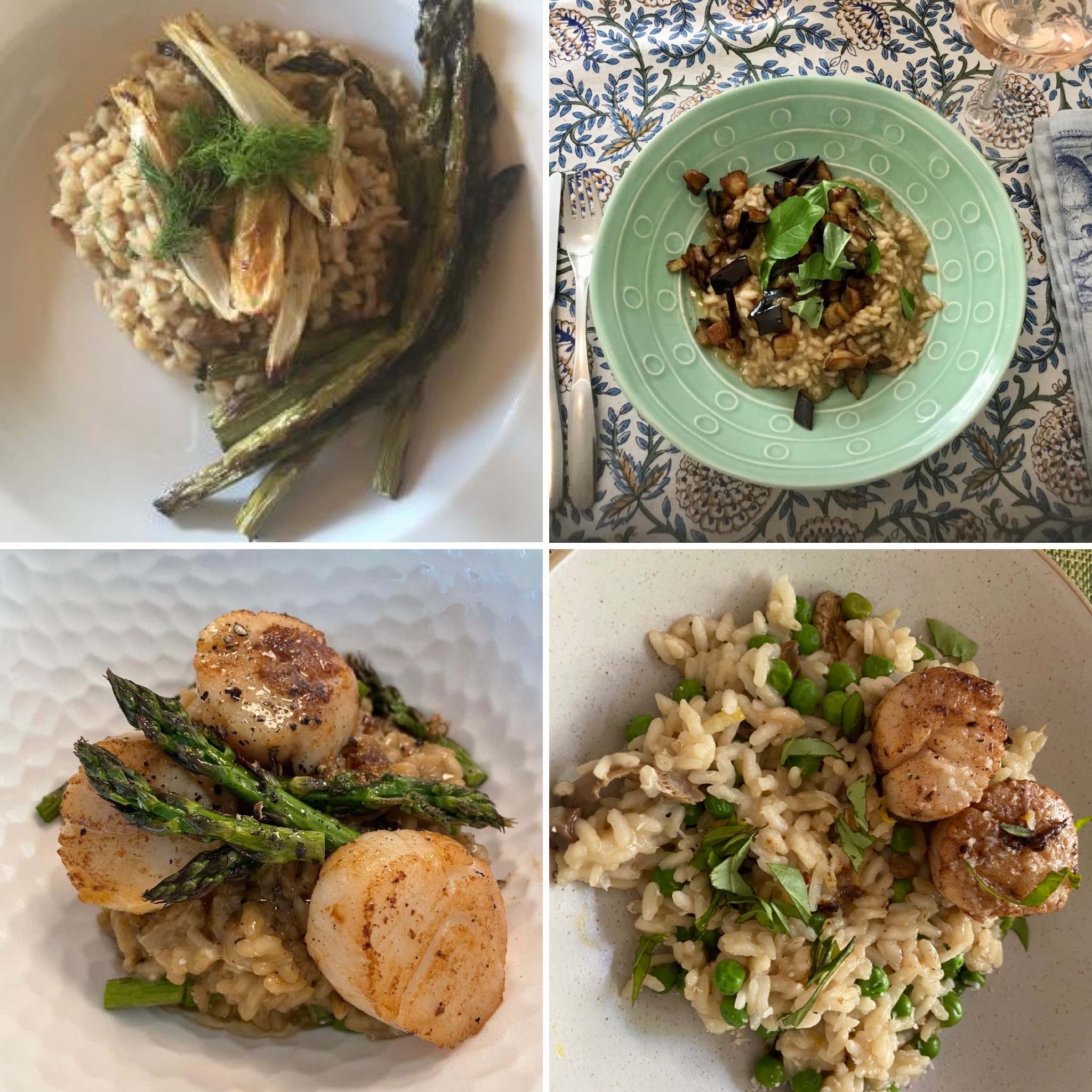
I look forward to Mark McEwan column in the weekend paper. His risotto write up inspired me to make the dish and I crowned the creamy rice with lobster claws. Well rehearsed, I looked forward to cooking it with my Epitourist gang. 

McEwan insists that the “#1" tip to a killer risotto is to master the stock and to keep it just below simmer to the side.” So, I obliged. I used carnaroli rice, Alsace Pinot Gris, roasted asparagus and pan fried scallops in copious amount of butter. 

Off heat, McEwan adds three spoonfuls of 35 % cream to finish this comforting dish. I like his post dinner pairing suggestion of a pavlova with early summer berries, lemon curd and peaked cream, yum!

Kaarina

I tend to time travel while stirring my risotto. My favourite trip is to the Amalfi Coast, where 20 years ago I blissfully savoured a seafood risotto in an unimposing small cafe on the edge of Priano harbour while watching the fishermen push their boats off the rocky shore. Then there was the New Year’s Eve when my friend Peter made the most memorable shrimp risotto ever. What made it so remarkable no one can say. Was it butter? Could it have been the champagne?

When I was casting about for fresh inspiration for our Epi Risotto Cook-Off, I didn’t have to look long or hard. Aubergine and Lemon Risotto popped up in the first search. A 2008 Guardian newspaper column by (who else?) Yotam Ottolenghi.

The recipe calls for two eggplants - one roasted whole to a creamy pulp; the second cubed and fried, rather like croutons. I took the liberty of replacing the lemon zest and juice with a finely chopped preserved lemon. I had my heart set on trying a new rose from Roussillon - Tesselae Rose by Domaine Lafage - while stirring the risotto and half of my glass found its way into the pot. Lovely.

P.S. The leftover risotto turned into dreamy Arancini  - fried risotto balls - for the next day’s backyard cocktails with friends.

Laura

Risotto is such a go-to comfort dish for me. I make sure I always have a package of Arborio rice in the cupboard, and I usually have homemade stock in the freezer (thanks to the ease of making it in the Instant Pot). Then it’s just a matter of rooting around to find some veg, herbs, and whatever meat or fish is around. And sometimes just a package of dried mushrooms will do the trick. This time I had some smoked mackerel, a fennel bulb, and some lovely Ontario asparagus on hand. 

I don’t use a recipe anymore. There’s not much variation in making a basic risotto. A quick Google finds Basic Risotto.  The only change I made was to sauté chopped fennel along with the onion. I also roasted a bit of the fennel along with the asparagus to finish the dish. This time I sautéed in olive oil, but sometimes I use butter. I always finish it by swirling in a knob of butter. I usually always grate in some Parmesan, but refrained from adding too much this time because of the saltiness of the mackerel. 

Diane

I don't generally follow a particular recipe for risotto, but do abide by the basic method of stir, stir, stir. Although at a previous Epi meal, I used Laura's Insta-pot to make a mushroom risotto and added scotch. 

This time around. I added a splash of vermouth to the rice when it was first toasting in the pan, and then flavoured the chicken stock with the broth from reconstituted dried mushrooms. Mushrooms, peas and basil were added with the parmesan. Pan-fried scallops to top.

A new ingredient for me was Meyer Lemon Honey Living vinegar, which I drizzled overtop to finish. Living Vinegar is literally alive, with living vinegar mother in every bottle. Raw and unfiltered, prebiotic, functional, and full of complex flavor. Created by Acid League, who say they were tired of only finding apple cider vinegar with these benefits, and so created Living Vinegar with a healthy dose of flavour. I love the taste and have been using it in salad dressings and cocktails, too. 


Sunday, April 11, 2021

Chef Thomas Keller's MasterClasses


This time around, Epitourists drew inspiration from Thomas Keller's MasterClasses. The chef has three distinct classes: Vegetables, Pasta and Eggs (I); Meats, Stocks, and Sauces (II); Seafood, Sous Vide, and Desserts (III). He generously shares insights garnered from decades of experience. 

His MasterClass is a joy to watch.

Chef Keller’s name is synonymous with quality and high standards. The chef and proprietor of The French Laundry, in Napa Valley, and Per Se, in New York, among other restaurants, he is the first and only American-born chef to hold multiple three-star ratings from the prestigious Michelin Guide, as well as the first American male chef to be designated a Chevalier of the French Legion of Honour, the highest decoration in France.

Yet there’s nothing pretentious about him despite having the bragging rights. There’s an old-fashioned civility and calm about the man that makes him an effective and favoured teacher. You learn there are no gimmicks - it’s all technique diligently executed. You become convinced that with practice and patience you too can do it in your own modest kitchen.

At one point, when the chef's parmesan crisp broke, he set it aside without a word and reached out for a perfect one that had been prepared ahead of time. He gently laid the thin tuile atop of the dish he had just plated. There’s no doubt this segment could have been edited out but instead, this great chef made a “teaching moment.” Yes, the perfect parmesan crisp was beautiful. He removes it and replaces it with pieces of the broken one. And they too are beautiful. Why did the crisp break? Because he allowed it to cool too much. Proof that even the experienced Michelin starred chef can make mistakes. 

After enjoying his MasterClasses, we prepared our courses for each other and then packaged them into individual take-aways to enjoy, Covid-style, at an afternoon Zoom lunch. We had the opportunity to share the food, as well as a few 'ah-ha' moments from lessons learned.

Menu
Salt tasting
Salad plate of roasted beets, asparagus, pickles and hardboiled egg
Potato Gnocchi
Chocolate pot de creme
Cheese plate
***

Salt Tasting

Keller had assigned a salt tasting for homework. We grabbed various salts from our cupboards.... sea salt, Himalayan, Maldon, fleur de sel, and iodized. Diane had also prepped some cumin sea salt, stealing notes from Alice Waters' MasterClass: it's just two tablespoons of sea salt and one tablespoon of cumin (toast the cumin seeds lightly in a cast iron pan and then when they're cool, grind them together with a bit of salt).

We noted that the finer grinds of salt were easily absorbed into the vegetable. The finishing salt, Maldon, added extra crunch and visual interest. Some of us found it hard to discern the different tastes, but the textures were unmistakable. In future we will have to try a full variety, including black volcanic salt, sel gris, or Hawaiian red.

Diane: Salad Plate


Chef Keller enjoys a simple breakfast of two hard boiled eggs almost every morning, bites of protein to start the day, so Diane incorporated some on the vegetable plate of roasted beets, boiled asparagus, and pickled veg.  

Seemingly simple, the vegetables did take time to prepare using Keller's techniques, but the effort was well worth the prize. Amazing colour, fresh taste, great texture. 

This Epi was totally inspired by the care Keller took in his demonstrations as he prepared vegetables: raw, roast, boil, glaze, braise, puree, pickle.... Such endless variety. 


Diane said she may never buy pickles again, as it was so much fun to layer the different vegetables' colours and shapes into jars. Such a pretty result! The brine was simple: 200 grams sugar; 400 grams water; 200 grams white wine vinegar; thyme sprigs; mustard seeds.


Caroline: Potato Gnocchi

Caroline summed up MasterClass I, II and III into one word: delightful. She observed his passion for l’art culinaire is palpable, inclusive (always uses “WE” never “I”), and authentic (admits he too makes mistakes). 


The first attempt of Gnocchi. Potato gnocchi (TKI. Lesson 33), took place a few days before the Epi Zoom lunch. That evening, it was served with a simple pomodoro sauce, but the results were not thrilling. The remainder of the batch froze well and promised to thaw quickly. 

For the second attempt, Caroline found a more interesting TK recipe to share with the Epis: Gnocchi with Mushroom and Butternut squash. This was a game changer. The ingredients appeal to the taste buds. “Butter! Give me butter! Always butter!” says Fernand Point, French Chef.

We enjoyed our TK lunch on a very cold and rainy Sunday. Served in a deep bowl and eaten with a spoon (a small one to make the pleasure last longer), the buttery, pillowy dumplings offered much comfort on such a day.


This course may indeed transform itself into an adventure as we anchor our boats in the calm on a summer's day. For our future inspiration, Caroline had tucked gnocchi paddles into the take-away packages. She made these for us from scratch so we could practise our rolling techniques. 

Kaarina: Chocolate Pot de creme


Being Easter time Kaarina thought it would be fun to make the chocolate pot de creme Chef Keller demonstrates in his third MasterClass series. With such basic ingredients - chocolate, egg whites, cream, a bit of sugar - the quality of the chocolate becomes paramount. Chef Keller prefers dark Nicaraguan chocolate but he gives us leave to use whatever chocolate we like best. Kaarina went for a dark 70% Belgian chocolate. 

Pot de creme is typically baked in the oven. Chef Keller makes his on the stovetop, and uses an immersion blender to give the custard a lighter mousse-like consistency, pours it into individual serving pots and refrigerates them for four hours before serving them topped with Chantilly creme and chocolate shavings. Using a bit more vanilla in the cream than Kaarina normally would, elevated the whipped cream topping to another level of deliciousness.

Kaarina found her demi-tasse with a pretty wreath of flowers around the rim were a perfect substitute for official pots de creme. The little cups were passed down from a great aunt who once a long, long time ago served as a maid in a fancy house in Leningrad.


Cheese Plate

Two aged cheddars and a creamy full moon. 

Diane and Kaarina both chose two-year-old cheddars so we had a chance to compare. The Empire cheddar made just outside Campbellford, Ontario was smooth but still managed strong flavour, the President's Choice brand had a sharper edge and saltier taste.

Caroline’s choice was Le Pleine Lune - a Quebec cheese with an English translation of Full Moon. Rolled in vegetable ash, creamy and with a tartish edge. Delicious!


Sunday, March 7, 2021

Elevated Home Recipes from Gordon Ramsay's MasterClass


Menu

Lobster Ravioli
Seared Sesame Crusted Tuna Steaks
Hoisin Glazed Crispy Shredded Chicken Salad, Pickled Daikon, and Honey Mustard Vinaigrette 
Cauliflower with Shiitake and Olive Pistou 
****

In this time of Covid we have continued our culinary adventures. During full lockdown, our gatherings are via Zoom. Although not the same thing, it is better than no thing. 

Dining with each other virtually adds new twists and possibilities. Those of us who live within an hour's drive can share our food, although it entails some delivery logistics.  Caroline, Kaarina and Diane can taste one another's offerings, while we drool over Laura's Wolfe Island dishes from a distance (and she over ours). 

Food delivery also means menu choices need to take into consideration offerings that can travel the distance; recipients must plate and finish the food in the oven or on stovetop once it arrives at its destination, so instructions are also included with each meal. 

In March, we continued the Masterclass theme we've enjoyed these past few months, with Gordon Ramsay as the inspiration. The classes include video demonstrations, so we got a glimpse of his (wOw!) kitchen. Ramsay's passion for food and fine ingredients comes across in his lessons, as does his blunt expression. We definitely learned a thing or two from his MasterClass.


Laura: Lobster Ravioli


Gordon Ramsay sure thinks a lot of himself. But with good reason, I guess. He’s quite an accomplished chef. I was surprised how much I enjoyed his MasterClass. I found I could endure his manic cockiness because the information he presented was actually worthwhile. 

I made the Lobster Ravioli. It was a heck of a lot of work for a couple of plates of ravioli, but it made for an entertaining day of cooking. I had some lobster tails in my freezer, leftover from my gig cooking for a duck hunting lodge this fall, so it was the perfect opportunity to make this over-the-top dish. The filling was quite simple—cooked lobster chopped up into a salmon and egg white that I puréed in the food processor to a mousse-like consistency. The pasta dough turned out well, although I stopped short of rolling it on the lowest setting on the pasta machine. Chef Ramsay says it’s essential to get to that final setting to make the almost see-through delicate sheets. Mine started to shred, so I gave up. Although it wasn’t transparently thin, it was still very delicate and tender. 

To make sauce, I boiled the lobster shells in chicken and beef stock along with a mirepoix of vegetables, straining, saving half to cook the ravioli, then reducing the rest down until it was thick and glossy, and then adding cream. There is a also tomato chutney to rest the ravioli on when plating, but I found that got a bit lost in the eating. The sauce is drizzled over the pasta, and the plate is garnished with microgreens with a lemon vinaigrette. I had forgotten to dig out my squeeze bottle for the sauce, so it wasn’t quite so delicately drizzled as Chef Ramsay’s version. 

I would definitely use the pasta recipe again. It is a lovely dough. However, I think I will stick with simpler fillings and sauces for my next batch.


Caroline: Sesame Crusted Tuna with Cucumber Salad 


I chose to prepare this dish for its use of tuna, a somewhat of an occasional treat ingredient, its ease of preparation and because it can be served at room temperature therefore eliminating the reheating hence diminishing the chances of compromising the desired end result.


Ramsay emphasizes the need to respect ingredients: “Treat tuna like you would an amazing wagyu steak — they deserve that respect.” I bowed down to my tuna, lined up the ingredients and began. 


Following chef Ramsay’s dandy recipe timeline, I set the finely julienned cucumber and sliced radishes to pickle in a 1:1:1 ratio of rice vinegar, water and sugar. It was pleasantly surprising to discover that cucumber holds up very well to being pushed through a mandolin on the delicate julienne setting. While at it, I quickly pushed through the radishes on the regular slicing setting, paused, counted my fingers and moved on to the Yuzu-Sesame Seed dressing. Yuzu, I learned (it’s the best thing about our Epi events, we’re forever learning new things), is a sour Japanese citrus fruit that has a very unique flavour and aroma. Unfortunately, it’s not easy to come by. Fortunately, the chef proposes a substitution of lime and lemon juice at a 2:1 ratio. Yuzu and lime juice, sesame and olive oil, all combined with salt, pepper and chopped up coriander make up this bold dressing.


Bowing to my tuna for one last time I lightly seasoned it with kosher salt and lime zest, brushed whipped up egg whites onto it, dipped it in the black and white sesame seeds (so beautifully dramatic) and delicately set it in the pan of hot grape seed oil: 30 seconds per side while scooping tablespoons of hot oil onto the top. Flip. Scoop. Scoop. Scoop. Finally tuna is set onto a cooling rack, hot oil from the pan poured over it. Zest. Zest. Zest of lime to crown it. Slice. Voilà, le tour est joué. 


Chef Ramsay’s MasterClass II present recipes based on dishes from his flagship, three Michelin starred restaurant, so plating is very important. The chef obliges beautifully and I must admit that following his detailed plating instruction, I created one of my most beautiful plates yet.


To summarize, I will admit that I wasn’t overly excited about doing Gordon Ramsay’s MasterClass because of what I had briefly seen by happenstance on Hell’s Kitchen. I will also add that his “watch and watch f*#@!n carefully” introductory comment really put me off 😳. I watched and carefully learned how to prepare this delightful tuna dish.


As Gordon said, "F%#@king delicious." This dish was fun to eat, because you tear the lettuce leaf and then wrap the chicken and pickles for casual bites you can eat with your hands. 

Part of our ongoing Epi challenge is to try something new. I have always avoided deep frying anything at home, for both dietary health and home safety reasons. Gordon demonstrated a shallow frying technique and explained how to control temperature by easing on and off the flame or adding additional oil. Now, I have added a new technique to my repertoire.

Rob assisted with the kitchen prep by pickling the ginger and white turnip (substituted for daikon). These bright flavours held their own and added a welcome acidic note for contrast.

I also had to figure out the best way to deliver the different salad components so Epis could assemble and plate at home. Pickles were easy: toss them and their liquids in a jar. The fried chicken was more of a challenge: transported in carryout tins, wrapped first in paper towels; and plenty of holes punched in the lid. Reheated just before serving in a pan or in the oven to keep it from getting soggy.

I used a mix of living butter lettuce and baby gem romaine for individual servings. You take each mini-head and peel the leaves down to create a flower for presentation. 

I would definitely make this recipe again, and I think deep frying is a nice touch. Even better when it can be served while it it still hot.


The cauliflower steaks bathed in olive oil and harissa (a North African blend of spices and smokey hot peppers) are first charred in a hot cast iron frying pan with foaming butter, then roasted in the oven for 15-20 minutes. Meanwhile, the mushroom, shallots and garlic are sautéed. The Olive Pistou, lemon zest and capers are folded into the mushrooms, the mixture is piled on top and finished with edible flowers or microgreens. Find the recipe at Cook Your Life.  

It doesn’t sound that complicated, but the various moving parts can be a challenge to an amateur (like me) so it’s smart to do the prep a day ahead. Chef Ramsay says the cauliflower steaks can be cut and refrigerated in ziplock bags with the harissa and olive oil marinade. Mushrooms, shallots and garlic can be chopped and refrigerated in air tight containers and the olive pistou can be made three days in advance.

Serve an entire steak as a rich, satisfying main course or share along with other small plates or as a side to fish, chicken or pork.

Saturday, February 6, 2021

Spring Chicken


Surprise!!!

Caroline and Diane showed up on Kaarina's doorstep on a Saturday morning with all the ingredients for the meal and to sing happy birthday. Kaarina looked lovely in her pj's and shivered graciously as she stood on her porch in sub-zero temperatures. 

We were celebrating Kaarina's birthday with an aptly chosen theme: Spring Chicken; the menu pulled from one of her favourite cookbooks, Simple, by chef Ottolenghi. The meal was curated in his book as a weekend lunch with friends. Yotam's recipes may be the contributing factor for the Middle Eastern flavours of preserved lemon, z'atar and tahini that have become pantry staples for the Epitourists these past few years.

Later in the day we enjoyed our lunch together via Zoom: 

Menu :Spring roast chicken and sides
 Spring roast chicken with preserved lemon 
 New potato with peas and cilantro 
Chopped salad with tahini and za'tar 
Sesame and hazelnut rolls 

Kaarina and Mike were both delighted by the birthday treat. Laura and Peter joined the virtual festivities from Wolfe Island while they carried out duties required for baking multiple loaves at their wood oven bakery.


Caroline had prepped the spring roast chicken with preserved lemon ahead of time so all we needed to do was place it in the oven and allow the heavenly scents of preserved lemon and garlic to waft through our houses to whet our appetites. Kaarina's and Mike's version was a Cornish hen, sized for two. New potato with peas and cilantro was a well-chosen side and delicious combination. Jimmy, Caroline's husband, agreed the lunch a welcome winter break.


Diane prepared the chopped salad with tahini and z'atar. The salad was fresh and colourful, a wonderful antidote for a winter afternoon. The tomato's texture was made more dense by removing the seeds and juice, and feta added salty zing. Tahini and z'atar completed the Middle Eastern profile.

Diane's husband Rob made the sesame hazelnut rolls, such nice bite-sized treats. The perfect accompaniment with coffee.


Friday, December 18, 2020

Christmas Cookie Exchange


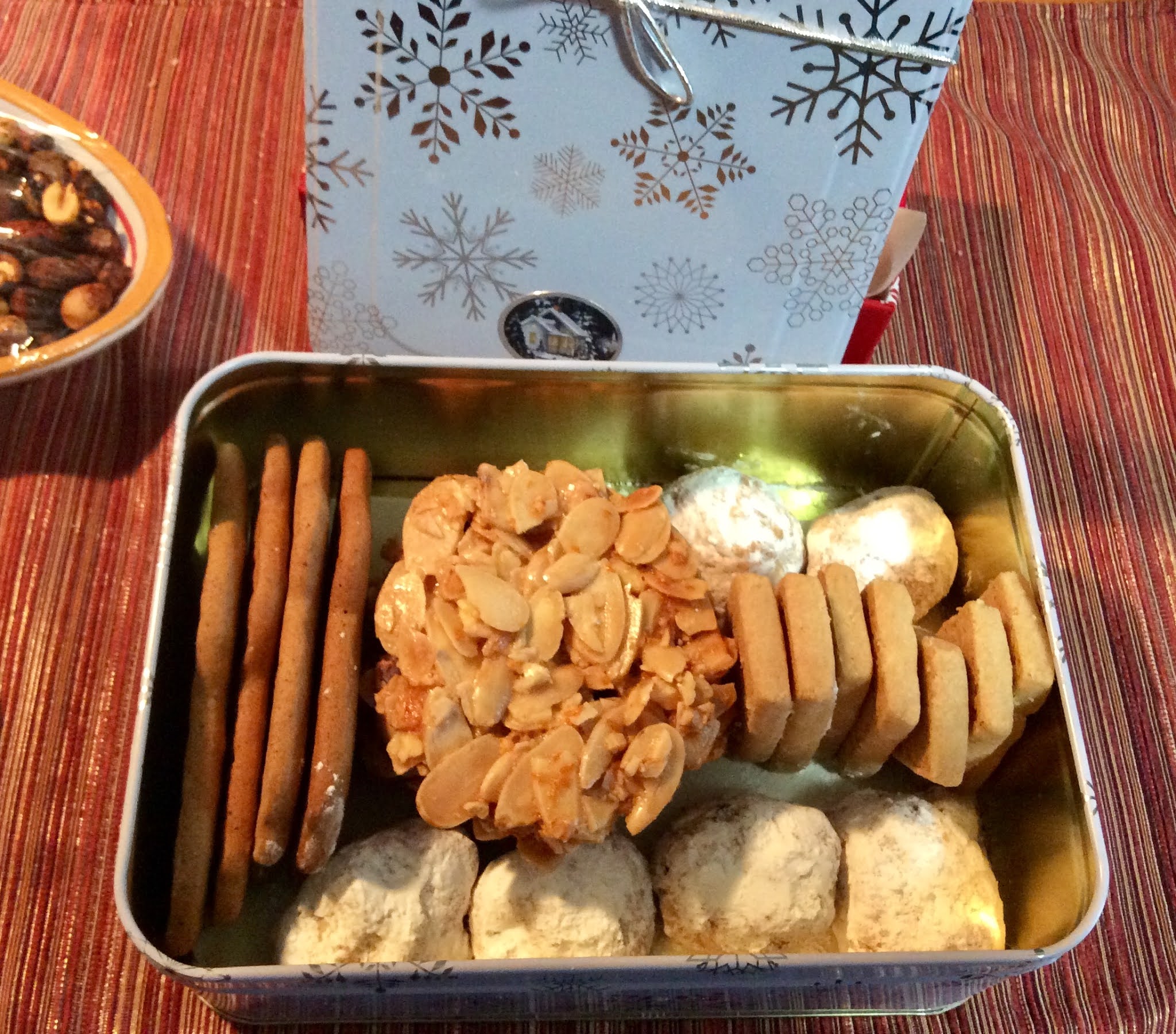
The Epi Christmas Cookie Exchange was such a success that even our men got in on the baking. Diane’s husband Rob and Kaarina’s Mike faced off with their shortbreads. Mike likes the macho version - big thick jaw-breakers fit for Highland lads. Rob’s are more refined - half as thick, softer, with a hint of lemon. Caroline’s Jimmy shared his stash of authentic fennel-laced biscotti gifted by Italian friends.

Laura and Peter missed out on the exchange but Laura did bake up a batch of Chocolate Chunk Shortbread fit for Santa Claus and joined our Zoom cookie tasting on the Saturday before Christmas.

Caroline has been trying to replicate the Chilli Pepper Chocolate cookies we love so much from our local Scarborough Bluff’s bakery, the Cliffside Hearth. She’s getting closer by putting her own spin on a Martha Stewart recipe for Spicy Chocolate cookies. Diane departed from the cookie theme by roasting up a batch of delicious Teriyaki Spiced nuts.


Kaarina isn’t much of a baker having grown up in a bakery where baking was serious business, done on a large scale with huge mixers, a massive two-level oven and a staff. It took Ottolenghi, the cookbook that made Chef Yotam Ottolenghi an international sensation, to tempt Kaarina into trying her hand at baking at home. In the Introduction, Ottolenghi addresses the “angst the idea of baking evokes in some.” He acknowledges that there’s grounds for the “phobia” since things can and do “go horribly wrong” but the “gratification of good baking is unbeatable ... and a clear mark of a mature cook.” He then promised that the selection of recipes in the book were mostly beginner friendly.

Ottolenghi’s Almond and Orange Florentines were reminiscent of a cookie made especially for Christmas by Kaarina’s family bakery. As this version is simple enough for a novice, she tackled it first. Once on a roll she moved on to another popular Italian treat, Sour Cherry Amaretti. Also easy and the results for both were stellar, something one could proudly include in a Christmas Cookie Exchange.


Almond and Orange Florentines


Makes about 20

Vegetable oil for brushing
2 free-range egg whites
3/4 cup plus 1 tbsp confectioners sugar
2 3/4 cups sliced almonds
Grated zest of 1 orange

Preheat the oven to 300°F / 150°C. Line a heavy baking sheet with parchment paper and brush lightly with vegetable oil. Next to you have a small bowl of cold water.

Put the egg whites, confectioners' sugar, sliced almonds, and orange zest in a bowl and gently mix them together. Dip your hand in the bowl of water and pick up portions of the mix to make little mounds on the lined pan, well spaced apart. Dip a fork in the water and flatten each mound very thinly. Try to make them as thin as possible without creating too many gaps between the almond slices. They should be about 3 1/4 inches / 8 cm in diameter.

Place the baking sheet in the oven and bake for about 12 minutes, until the cookies are golden brown. Check underneath one cookie to make sure they are cooked through.

Allow to cool, then gently, using an icing spatula, remove the cookies from the baking sheet. Store in a sealed jar. 

Sour Cherry Amaretti


Makes 20

60 g dried sour cherries (or cranberries)
120 g caster sugar
180 g ground almonds
1/2 tsp almond extract
zest one lemon
pinch salt
2 tsp honey

2 egg whites
icing sugar

Heat oven to 325F (170C). Mix together the almonds, sugar, lemon zest, almond extract and salt using your fingers to disperse the zest evenly. In a separate bowl, whisk the egg whites and honey into soft peaks. Fold these gently into the other ingredients to a soft meringue consistency.

Divide the mixture into 20 balls, roll liberally in icing sugar, and place on a parchment-covered baking tray. Bake for about 12 mins, until slightly coloured but still pale and chewy in the centre. Cool completely before storing in sealed jar.

Caroline’s Spicy Chocolate Cookies


For this recipe from Martha Stewart, Caroline used Lindt’s dark chili chocolate for choco chips, doubled the cayenne to 1/2 tsp and topped the cookies with Maldon salt instead of sugar.

Diane’s Teriyaki Spiced Nuts

(The mixture includes almonds, pistachios and cashews)


Laura’s Chocolate Chunk Shortbread

2 cups butter
1 cup of fine sugar (blend in food processor if you can’t find instant-dissolving, fruit sugar)
3 1⁄2 cups flour
1⁄2 cup of rice flour
12 oz dark chocolate, chopped into bit-size chunks


Beat butter until light gradually add sugar until dissolved (about 5 minutes).
Sift flours together and stir into butter until well combined.
Save 50 of the biggest chunks of chocolate for the top of cookies and mix the rest into the batter.
Scoop dough onto baking sheets lined with parchment. Press a chunk of chocolate in the top of each cookie.
Bake 20-25 minutes at 325 until lightly browned cool on racks and dust with icing sugar.

Saturday, December 12, 2020

Mezze Christmas


When Diane announced in late November that our favourite chef Yotam Ottolenghi had turned up on MasterClass, Caroline and Kaarina rushed to share a 2-for-1 membership. When after watching the first few video lessons of Ottolenghi Teaches Middle-eastern Cooking on the online platform, Diane proposed a mezze feast,  we were immediately on board.

Menu
Muhammara
Smoky Pea Spread with Marinated Feta
Hummus with Garlic Confit

Clearly we would not be having in-person Epi gatherings any time soon. There wouldn’t be any Holiday parties and even family Christmas dinners were doubtful as the second wave of Covid-19 was taking hold in Ontario.

We missed our get-togethers, sharing news, food and wine as well as the inspiration, the challenge and encouragement we get from one another. Like virtual meetings or not, we needed to Zoom.

This time we were determined to share, if not the actual table, at least our cooking. I volunteered to be the delivery service. The food had to be prepped ahead and had to travel well. Mezze was perfect for make-ahead. And Ottolenghi was the right man to show us how to do it.

Kaarina selected Lesson 1 - Muhammara

This gorgeous roasted red pepper dip with shiny pomegranate seeds looks like Christmas on a plate. It originates in Syria and Lebanon but is made across the region. The walnuts add crunch and the pomegranate seeds provide a sweet, slightly acidic pop. You scoop it up with flatbread. Crackers with seeds also work well. 


Ingredients
  • 3 red bell peppers, halved, stemmed, and cored
  • 2 cloves garlic, smashed
  • ½ cup extra virgin olive oil, divided, plus more if needed
  • 1 cup walnuts
  • 1 teaspoon kosher salt, plus more to taste
  • 2 tablespoons red pepper flakes, preferably Aleppo-style
  • 1 tablespoon pomegranate molasses
  • 1 tablespoon freshly squeezed lemon juice
  • 1 cup breadcrumbs, preferably unseasoned, fresh breadcrumbs
  • 1 teaspoon ground cumin
Preheat the oven to 400 degrees Fahrenheit.
Arrange red bell peppers and garlic cloves on a baking sheet and drizzle with 2 tablespoons olive oil. Roast until peppers are tender and slightly charred, about 20 minutes. Transfer roasted peppers to a plate to cool, and squeeze the garlic cloves out of their skins.
Meanwhile, toast the walnuts. In a large skillet over medium heat, toast the walnuts in an even layer, stirring occasionally until fragrant and lightly browned, about 5 minutes. Rub warm toasted walnuts in a folded kitchen towel to remove as much of the bitter skins as possible. (It doesn't have to be perfect.) Transfer the walnuts to a plate to cool.
In the bowl of a food processor, combine cooled roasted peppers, garlic, walnuts, salt, Aleppo pepper, pomegranate molasses, lemon juice, breadcrumbs, cumin, and remaining olive oil. Process until smooth. Taste and adjust seasoning.
Transfer to a serving bowl and drizzle with olive oil. Serve with flatbread.

Diane chose Lesson 2: Smoky Pea Spread with Marinated Feta


It seems an unlikely pairing - peas and feta - but the combination is downright addictive. 

The feta adds richness and saltiness to the sweet, peas. 

Ottolenghi’s MasterClass directions for the Pea Spread are super simple:

Add into a food processor
600 grams of defrosted frozen peas
10 grams tarragon and 5 grams mint, roughly chopped
1 crushed garlic clove
1 1/2 tsp lemon zest
2 tbsp lemon juice
4 tbsp olive oil
Salt and pepper
Pulse a few times to form a coarse paste. Taste, add more lemon juice and/or salt. It should taste fresh and bright.

Ottolenghi’s Smoky Marinated Feta  recipe makes lots and can be made well ahead of time. “It will keep in a sealed container in the fridge for up to a week. Have it on toast for breakfast or with pita and a glass of wine for an anytime snack,” Ottolenghi recommends.

Ingredients
  • 10 garlic cloves, peeled
  • 1-2 lemons – zest finely shaved into 8 strips, and juiced, to get 1½ tbsp
  • 4 bay leaves
  • 2½ tsp chipotle chilli flakes
  • 1½ tsp paprika
  • 250ml olive oil
  • 1 tsp flaked sea salt
  • 2 blocks Greek feta (360g), cut into 2cm cubes

Put a small saute pan on a medium-high heat. Once very hot, add the garlic and cook for about three to four minutes, turning halfway, until charred on the outside. Add the lemon and bay leaves, cook for 90 seconds more, then add the chipotle and cook, stirring continuously, for about 30 seconds, until well toasted and fragrant. Off the heat, stir in the paprika, oil and salt, then leave to cool completely.

Once the mix is cold, stir through the feta, then transfer to a bowl or glass jar and leave to marinate, at room temperature if you plan to eat it within the next couple of hours, or refrigerated (and covered) if you’re having it later. Take the feta out of the fridge about an hour or so before you want to serve it, for the oil to come back up to room temperature.
To serve: Spread the pea mixture on a shallow plate and top with 100 grams of smoky marinated feta including 3-4 tbsp of the marinating oil, bit of lemon peel and few garlic cloves. Sprinkle it 1/2 tsp of toasted and crushed crushed cumin seeds. Enjoy with flatbread.

Caroline mastered Lesson 3: Hummus with Garlic Confit


Store-bought and even restaurant-made hummus pale in comparison to Ottolenghi’s version of the Mideastern staple.
 
The key is cooking your own chickpeas, Ottolenghi says. Start by soaking 200 grams of chickpeas overnight in water and 1 1/2 tsp of baking soda, which helps to break down the skin and allows the chickpeas to absorb more water, making for a smoother hummus. His advice is not to salt the water until the final 15 minutes of cooking or the chickpeas will never soften. Cooking can take from 30 to 60 minutes. They need to be soft but not mushy.

As to tahini paste (ground roasted sesame seeds) Ottolenghi prefers ones from Israeli, Lebanese, Syrian and Palestine.

Hummus

Ingredients
  • 60 grams Tahini Sauce (see recipe linked below)
  • 12 confit garlic cloves, plus 4 tablespoons Confit Garlic Oil (see recipe linked below)
  • 550 grams cooked chickpeas
  • 180 grams to 210 grams tahini paste (depending on the brand)
  • Salt
  • 1/4 cup lemon juice
  • 5 tbsp plus 2 tsp ice-cold water, plus extra
  • 1 ½ tablespoons parsley, finely chopped
Set about 100 grams of the cooked chickpeas aside in a small bowl.
Add the remaining chickpeas, tahini paste, 8 of the confit garlic cloves, ½ teaspoon salt, and the lemon juice to the bowl of a food processor and blitz until smooth, 2–3 minutes.
With the machine running, slowly drizzle in the ice water until completely smooth and aerated. You may have to add slightly more water to reach the desired texture. Taste and adjust for seasoning if necessary.
Add the parsley, 2 tablespoons of Confit Garlic Oil, and a pinch of salt to the bowl with the reserved chickpeas, and stir to combine. Set aside.
Transfer the hummus to a shallow platter and smooth it out with the back of a spoon, creating a slight well in the center. (It’s okay if the hummus is a little runny; hummus will set as it cools.) Spoon the herbed chickpea mixture over the top of the tahini. Top the dish with the remaining confit garlic cloves along with some of the aromatics in the jar (thyme and chili). Finish with a drizzle of Confit Garlic Oil.


Garlic Confit

Ingredients
  • 12 peeled garlic cloves
  • 6 thyme sprigs
  • 1 green chili
  • 200 ml olive oil
  • Salt

Combine all ingredients in a small sauce- pan over medium-low heat. Cover and cook until the garlic is soft and just beginning to color, about 20 to 25 minutes.
Leave the lid on, remove from the heat, and set aside for 10 minutes; the garlic will continue to cook in the heat of the oil.
Strain the oil into a clean glass jar and spoon in the garlic, thyme, and chili.
Once cool, transfer everything to an airtight, sterilized jar and store at room temperature for several weeks.


Saturday, September 12, 2020

Harvest Bounty

Menu

Salmorejo
Tomatoes with Sumac Shallots
Zucchini with Thyme and Walnut
Cod, Clams and Corn with Parsley
Sabayon

Such abundance in September! Still in the time of Covid, we got together in Kaarina's backyard Bamba Shack but eventually moved indoors - social distancing, of course. Lovely Laura was unable to join, so it was an Epi trio of Kaarina, Caroline and Diane.

Kaarina
 
Salmorejo

If there’s one thing I’ve learned in this journey with my friends, the Epitourists, it’s that great food doesn’t need to be complicated. Like there’s no need to over direct a cob of corn. A bit of butter, a sprinkle of salt and it will sing all on its own.

So the Epitourists’ September Harvest Bounty production followed the Keep it Simple, Keep it Local and and Keep it Seasonal rules. The stars of the show were local Ontario corn, tomatoes and zucchini with a supporting cast of garlic, shallots, thyme, parsley and basil, Niagara peaches and Concord grapes. The guests  - fresh clams and cod - came from the East Coast.Our welcome G&Ts were infused with basil from a pot in my garden. Our first course, Salmorejo, a cold Spanish tomato soup from Córdoba, was laced with fresh garlic from Laura’s Wolfe Island garden. 

Salmorejo, not to be confused with its cousin gazpacho, is super quick to prepare and an easy hot weather solution to a bumper crop of tomatoes if you’re lucky enough to have one. No cooking involved. You need ripe tomatoes, rustic bread, garlic, olive oil, Sherry vinegar and a food processor. I used a traditional garnish of boiled eggs, Serrano ham and pitted olives. Here are no-fuss directions from my Spanish food guru, chef Jose Andres.

Diane


In charge of the salad course I consulted Ottolenghi's Simple for the recipes: tomatoes with sumac shallots and zucchini with thyme and walnut. 

I was able to use fists full of fresh basil and thyme from plants out my back door. Making these colourful salads was a very visual and tactile experience for me: peeling long curls from the zucchini; massaging fragrant oil into the white flesh; gently lifting the multi-coloured tomatoes to hide bits of fresh green basil. 

After the salad course I watched Caroline prepare fresh clams as I'd never had them before. Not as intimidating to cook as I thought, and a real show with all the sizzle and steam. But then, Caro does make it seem easy. The Bon Appetit recipe called for a generous amount of shallots in the bottom of a hot pan, fresh white wine added to evaporate for one minute, then add the clams and steam for another 5 minutes. Delicious brine drizzled on top and served alongside fresh corn and cod browned on the skillet. 

For an encore Kaarina disappeared into the kitchen to whip up sabayon. Smooth and silky, it warmed up the last of the season’s Niagara peaches (still so sweet), raspberries and blackberries. This Julia Child classic will wrap up any meal in style.

After, a selection of cheeses, concord grapes and crackers, a splash of Scotch.

Feasting on each other's company.