Sunday, October 3, 2021

A Farmers' Market Inspired Menu


Menu

Leek and Mushroom Soup with a Goat Cheese Crostini
❧
Pippa Goat Crottin and Chive Omelet with Steamed Green Beans
❧
Red Fingerling and Smoked Trout with Asiago Cheese
❧
A Salad of Radishes and their greens with Baby Kumatoes

Caroline

Fall is upon us and so is the desire to get back to a slower pace, a comforting routine and menu. So with this in mind, I decided to resume the MasterClass with Alice Waters, founder and owner of California’s renowned Chez Panisse.

It is surprising that this woman has no formal culinary education yet, she has influenced the paths of so many young chefs, food writers and founders of notable food-related businesses. Her love of bringing people together around a table with the freshest of ingredients is the base of her philosophy. And her class is about a philosophy of food. She encourages her pupils to “cook with spontaneity, building your confidence so that you can leap away from a script.” Her teachings are those of our “grandmothers and our grandmothers’ grandmothers”. Fresh. Organic. Harmonious. Natural. Biodiverse. Sustainable. She balks at the fast food culture that has taken over our lives but, she is hopeful. 

“Don’t go to the market or store with a shopping list. Buy what looks alive and inspiring, and plan your menus when you get home.”
— Alice Waters, The Farmer’s Market / Learning from the Source

With this quote as our shopping guideline, we headed to the Uxbridge Farmers’ Market.

I blazed through the market and quickly filled my basket: butternut squash, local ginger root, fresh farm eggs, fingerling potatoes, leeks, pectin free sour cherry jam, black olive sourdough bread, two cheeses (Pippa goat cheese crottin and Shepherd’s Harvest aged sheep cheese), garlic and ears of fresh corn.

I had a couple of soup ideas in mind or maybe a simple herb and cheese omelet.

When we got back to the kitchen, we laid out our market purchases and began jotting down ideas: soups: butternut squash and ginger, leek and potato, broccoli and leek with blue goat cheese, leek and mushroom with a brie on black olive sourdough crostini, Pippa goat crottin and herb omelet, salads: radish and their greens with tomato,  beet on a bed of spicy greens with chèvre, mushroom on a bed of spicy greens with chèvre, fingerling potatoes and smoked trout with Asiago … so many inspired ideas!

Kaarina ❧ Leek and Mushroom Soup with Goat Cheese Crostini

I came home from the market with enough red and golden beets, radishes, white Sicilian eggplants, zucchini, broccoli and bitter greens to feed an army of vegetarians for a week. And I didn’t use any of them in my Alice Walters Market Lunch. The leeks and mushrooms, Shiitake and Cremini, were the clear winners. They found their way into the soup pot for our first course. A few tablespoons of crème fraîche stirred into the pot at the end and goat cheese crostini floated on top finished the dish. The recipe was a riff on this Leek Soup with Brie Toasts . I did not use any flour to thicken.

The bloomy cheese — Mason’s Delight from River’s Edge Goat Dairy  in Arthur, ON — delivered just a bit of zing while the dark vegetable ash veins running through it added all kinds of visual appeal. So artsy I wish I could take credit for planning it.

Caroline ❧ Pippa Goat Crottin Chive Omelet with Green Beans

 
A simple goat cheese omelet is so satisfying. The tangy filling is a perfect match for eggs. I questioned the market fromager about using a bloomy rind cheese. He responded that they “use it all the time in omelets”. Although the Pippa was delicious, I wished I had gone with a spreadable goat selection, say a caramelized onion and green peppercorn.

The omelets quickly came together and Diane steamed some green beans which when ready, were tossed into the empty omelet pan with a generous amount of butter, salt and a sprinkle of hot pepper flakes.

More about the Pippa Goat Crottin: “From Grey County, this is Wild Meadows Farm’s most exclusive cheese, inspired by the classic crottin style cheeses found in the south of France. This style of cheese is a rare find in Ontario. Pippa is creamy, with some firmness, and has woodsy and mushroom notes, complete with a gentle bite. It is made from WMF fresh chèvre. It is hand rolled and aged until a soft white mold rind grows on the outside.”

Oh how we love thee cheese!


Diane ❧ Red Fingerling and Smoked Trout with Asiago Cheese
and Salad of Radishes and their Greens with Baby Kumatoes

 
The Sunday market was filled with colourful produce and offerings from local artisans. My first stop was a garlic producer who had 6 different types on display, each with different colours, sizes, and smells.

In addition to fresh squash, beets, cherry tomatoes and herbs, my arms were laden heavily with meats, smoked fish, cheese, and some gin from a local distillery called The Durham. 

The only preparation really required for my first 'dish' was to boil the red fingerlings. I tried using Caroline's InstantPot, just to see if it would help retain the potato's flavour more than a regular boil. They were delicious! The smoked trout was served alongside, with a dollop of crème fraîche and fresh parsley. The Asiago was smooth, semi-soft, and slightly aged for a sweet and nutty flavour. All the tastes and textures worked quite well together, although next time I would add some crunch with crackers or pickles. 
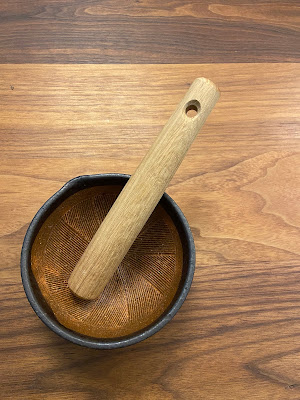
When Alice raved about her Japanese Suribachi ("grinding-bowl") in her MasterClass I was inspired to buy one for myself. It's a beautifully crafted bowl, with ridges perfectly designed for grinding spices and pressing garlic; the bowl has a gentle lip to make it easy to pour the finished dressing over the salad. Here's a quick demo of Alice Waters using the suribachi to prepare a garlic vinaigrette with Martha Stewart.

It really is a  pleasure for all the senses to prepare a vinaigrette and simple salad. The sound of the knife chopping on the wooden cutting board and friendly chatter in the kitchen. A small taste of the bitter greens told me they wanted a touch of honey added to the dressing.  The tomatoes calling for pepper and the radish wanting some salt. All the veg were colourful and beautiful — the black radish dark as black pepper on the outside and porcelain white inside, and as soon as they were cut open a zesty scent burst from the skin. A few tiny watermelon radishes were stolen from Kaarina, because they added such a pretty element to the plate with their blushing centres. Music garlic enlivened the dressing, along with aged sherry vinegar. The fresh greens sat in the dressing for awhile to soften them up. Alice Waters mixes her salads with her hands, gently tossing and arranging, so in addition to sight, smell, and taste, there is the added pleasure of touch. ❧


Wednesday, September 29, 2021

Sumptuous Summer Menu inspired by Marcella Hazan


The Essentials of Classic Italian Cooking is a wonderful collection of recipes, with explicit directions on timing and technique, to help you bring the best of Italian kitchens to your table. 
There is no such thing as Italian haute cuisine -  there are no high or low roads in Italian cooking. All roads lead to the home, to la cucina di casa - the only one that deserves to be called Italian cooking. (Marcella Hazan in the Introduction of Essentials)
Fresh pasta making was involved! Caroline brought her motor and we hitched it to Diane's hand cranked pasta machine to produce silken dough that was hand cut at the table, and then dropped into vigorously boiling water. You can't get pasta any fresher than this!


Our feast was inspired from the pages of Essentials of Classic Italian Cooking:

Sumptuous Summer Menu
Venetian primi, salmon with radicchio and balsamic
Papparadelle with Red and Yellow Bell Pepper Sauce with Sausages
Roast chicken with lemons, followed by Green bean salad
Black and White Macerated Grapes
Affagato


Kaarina: Venetian primi, salmon with radicchio and balsamic 
wine match: , Nebiolo 2019 Fontanafredda DOC 


Marcella taught me to cook. Some 30-odd years ago my friend Ron returned to Canada from 12 happy years eating in Rome and gifted me two Marcella Hazan cookbooks. They came with apron strings attached. I was to learn Italian home cooking and invite him to dinner.

What I learned was not so much Italian – that is, what North Americans think of as Italian – but good every-day home cooking. It becomes dinner party fare by adding a course or two and serving the meal according to Marcella’s rules on the art of Italian dining.


The genius of Marella’s cucina is its simplicity and precision. You always, always, always start with the freshest ingredients – and not too many of them. Her recipes rarely call for more than a half dozen things. “What you keep out is as significant as what you put in,” she wrote in the Introduction to Marcella Cucina. (Her velvety tomato sauce of world renown has only three ingredients: tomatoes, onion and butter.) 

I chose Steamed Salmon with Radicchio and Balsamic Vinegar for our Epi lunch as an example of how a few carefully chosen, common ingredients can be transformed quickly into something quite unique. The main players in this Venetian production - salmon wrapped in radicchio, steamed and drizzled with Balsamic vinegar – seem an unlikely trio. The supporting cast is limited to EVOO and S&P. The result is perfect dinner party fare either as a primo or main course. I thought the dish needed a fruity full wine, so I chose a Nebbiolo, the Barolo grape. It played together very happily with the competing strong flavours, although I expect a good classic Chianti would also do the job.

Caroline: Papparadelle with Red and Yellow Bell Pepper Sauce with Sausages
wine match: La Luna e i Falo, Barbera D'Asti, 2017 Vita Colte DOCG


Having heard my fellow Epis frequently mention and reference Marcella Hazan, last winter I ordered a copy of her Essentials of Classic Italian Cooking. So in the hopes of putting the cookbook to good use, I took it with me on the boat this past summer. The stale sourdough bread was transformed into her panzanella. Laura’s green beans were cooked just right as per her precise instructions. And in preparation for our Wolfe Island pizza night, I read the section on pizza which also covers toppings. And if memory serves me right, Kaarina made her marinara topping in honour of the sailors anchored in Breaky Bay. Marcella was very much with me this summer. It all seemed so natural to celebrate her so we agreed to cook Italian her way for our September Epitourists lunch.

Things I learned when I prepared Marcella’s Red and Yellow Bell Pepper Sauce with Sausages served on fresh pappardelle:
  • The cookbook was first published in 1973 at a time when Italian ingredients were not accessible in North America, so Marcella suggests the use of unbleached all purpose flour to make fresh pasta in lieu of the 00 or doppio zero. BUT, we can now purchase 00 flour! So, I made pappardelle: 200g of 00 flour, 2 eggs and a pinch of salt!
  • Semolina di grano duro is for industrially produced pasta. She does not find it suitable for homemade pasta as it is “often too grainy”.
  • The recipe says to peel the bell peppers. I have never peeled a pepper. I tried. It wasn’t pleasant. I gave up. I contemplated oven roasting them followed by a sweating session in a closed container and then removing their skin but, I feared that this would modify the texture of the peppers to an extreme. Marcella was watching… I feared her reprisal. In the end, I didn’t peel. Oh well! I did come to understand that there’s a reason behind her detailed instructions (hhmm, have I heard K mention this before?).
  • Don’t let the simplicity of the ingredients fool you, this sauce is absolutely delicious. It is lightly sweet and velvety rich!
  • One last word, I cut the sausage in tiny bite size pieces instead of her suggested 1/2” because it just looks prettier on the plate.
Diane: Roast chicken with lemons, followed by Green bean salad
wine match: Capitel Nicalo, Valpolicella, 2018 Tedeschi DOC Superiore


Roast chicken is a mainstay on home menus across the world, and this simple version is going into regular rotation at my house because it produces such delicious, moist, and lemony results.  

Roast chicken with lemons requires "No fat to cook with, no basting to do, no condiments but salt and pepper. After you put it in the oven you turn it just once." One technique I learned from Marcella's recipe was to soften the lemons by rolling them back and forth on the counter while applying pressure from the palm of your hand; then poking the lemons with a sharp stick so they release their steams and juices. The other secret here is to cook the bird, breast side up, for the first thirty minutes before flipping it over for the remainder of the cooking time (allow about 20 minutes per pound). Otherwise, the bird is self-basting. Active time: 15 minutes; total time, 2 hours.  

Likewise, her Green Bean salad was straightforward and simple. Soaking the green beans for ten minutes prior to cooking plumped them up. Ten minutes in boiling water and then snapping off each end, then dressing with fine quality olive oil, sherry vinegar, and maldon salts. The only quibble I had with this recipe was that snapping off the ends of the beans produced a lot of waste, although it did ensure that only the best and most favourable pieces were brought to table. 

Diane: Black and White Macerated Grapes


What a beautiful bowl of fruit! 

Although neither the black or white grapes from the grocery store could be as flavourful as Italian grapes in season, this was still a nice light dessert that was easy to pull together. Just halve the grapes, remove the seeds if any, and soak in the juice of freshly squeezed oranges with a tablespoon or two of sugar for two to three hours, and then serve.

Diane: Affagato

Pure vanilla ice cream with a splash of hot espresso marries hot with cold; light with dark. Simple and delicious!


Wednesday, June 23, 2021

Garden Party

Menu
Sarnie
Strawberry Shortcake
Fresh Fruits


A breath of fresh air and a season of growing hope!

Covid cases were falling, people were getting vaccinated, and it seemed life might soon return to normal. Indoor dining still came with restrictions, but we were craving food and company. 

So on a sunny afternoon in the early days of summer, Kaarina, Caroline, and Diane got together again in Kaarina's backyard Bamba Shack, surrounded by her lovely garden. Although our virtual get-togethers have been fun, being together in person was reason to celebrate.

Caroline and Kaarina prepared seasonal dishes, and welcomed Diane's humble offering of simple fruits to finish the meal. 

Caroline: Sarnie


This is not the dainty pinwheel, triangle or finger sandwich found at your traditional tea party. This is roll-up-your-sleeves and grab-a-knife-and-fork queen-sized sandwich.

I recall sending my husband a picture of the stacked sarnie from Jamie Oliver's Ultimate Veg cookbook. In my text I said: “When this is over [the pandemic] I will make this.” As restrictions slowly lifted after the third wave, the Epitourists finally could get together for lunch. A perfect opportunity to make this beautiful sandwich. I planned my biweekly sourdough bread making to coincide with our lunch date. Fresh bread at the ready, I gathered up the ingredients to make the sarnie. Once sliced halved and quartered, all the vegetables were grilled on the BBQ. I must confess that it absolutely broke my heart to extract the crumb from a freshly baked loaf of bread. As the recipe indicated, I saved it to make croutons. Once dressed, I stuffed all the ingredients into the hollowed bread cavity. Surprisingly, it all fit and the end result weighed approximately 4 kg. Tightly wrapped in cellophane, I refrigerated the sarnie overnight under the weight of a heavy cast iron pot.


Served alongside a bed of delicate greens and herbs picked fresh from the garden, the sarnie was a treat.

I have since made a similar version of this recipe on the mighty wee trawler Ruby Tuesday. I used cured, black olives, fresh rosemary, olive oil, red wine vinegar, and goat cheese as a dressing. I left out the cauliflower and added grilled mushrooms and rapini. Anything goes here. Your imagination is the limit.

Karrina: Strawberry Shortcake


When local strawberries arrived at my green grocer in June, the heady fragrance triggered memories of cake and whipped cream piled high with crimson berries. Yes! It was strawberry shortcake season! What better excuse for an afternoon garden party? And what better time for one than than Summer Solstice?

I have observed that I buy strawberries with my nose. I pick up a box and bring it to eye level, take a deep breath through my nose and if I don’t detect that heady sweetness that sings “Summertime,” I move on to other fruit. 2021 was a great year for strawberries - at least according to my olfactory epithelium. We ate a lot of them. As I said, the nose knows.

For my garden party strawberry cake I settled on a simple European sponge cake rather than a shortcake just because I like a classic genoise. It’s so versatile, great for all kinds of fillings and toppings. And simple. Just three ingredients - 6 eggs, 1 cup sugar and 1 cup flour. No butter. Beat the eggs and sugar together until it triples in volume, gently fold in the flour by thirds and pour into a 9-inch springform pan fitted with parchment on the bottom. Bake at 350F for 30 minutes or until a toothpick comes out crumb free. Voila! Simple.

When the cake is cool - preferably the next day - slice it horizontally so you have two rounds. Slice 2 pounds of strawberries with a teaspoon or two of sugar and set aside for an hour to macerate. Whip up two cups of 35% cream with a teaspoon of sugar and a teaspoon vanilla. Pile up plenty of whipped cream and sliced strawberries on the first round of cake. Place the second round on top and pile on more strawberries and cream. Finish with cream and decorate with whole or half strawberries. Refrigerate until ready to serve.


Sunday, May 16, 2021

Spring Risotto


In the spirit of online cooking classes, and as Covid stubbornly continues to prevent us from gathering in person, we thought it would be fun to plan a menu we could all prepare and cook together in our separate kitchens.

Caroline chose the dish - risotto. Perfetto! Something we could personalize and that would allow for good, stirring conversation.

There are three different types of rice that are most suitable for risotto: carnaroli is known as the 'caviar' of risotto rice (the creamiest and most forgiving to cook with); vialone nano, which is a shorter grain grown in the Veneto region; and arborio, which is the most widely available. 

Risotto is a wonderful meal unto itself and endlessly adaptable to the season. This is definitely a versatile dish with recipes as plentiful as the individual cooks.

On this beautiful sunny spring evening we enjoyed our variations on the theme and imagined the taste of other plates. Hopefully, soon, we will be able to share a lunch in person.

Caroline 

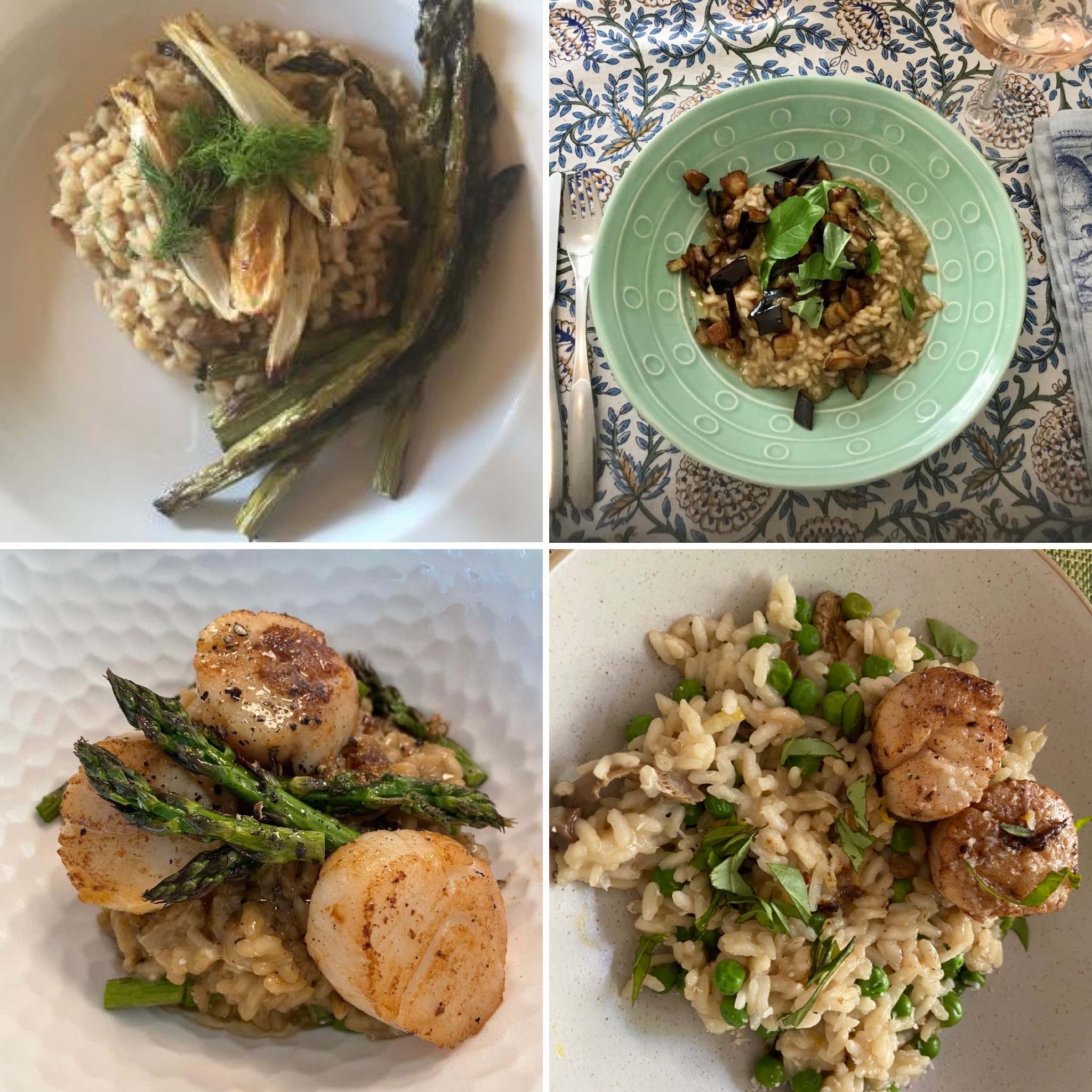
I look forward to Mark McEwan column in the weekend paper. His risotto write up inspired me to make the dish and I crowned the creamy rice with lobster claws. Well rehearsed, I looked forward to cooking it with my Epitourist gang. 

McEwan insists that the “#1" tip to a killer risotto is to master the stock and to keep it just below simmer to the side.” So, I obliged. I used carnaroli rice, Alsace Pinot Gris, roasted asparagus and pan fried scallops in copious amount of butter. 

Off heat, McEwan adds three spoonfuls of 35 % cream to finish this comforting dish. I like his post dinner pairing suggestion of a pavlova with early summer berries, lemon curd and peaked cream, yum!

Kaarina

I tend to time travel while stirring my risotto. My favourite trip is to the Amalfi Coast, where 20 years ago I blissfully savoured a seafood risotto in an unimposing small cafe on the edge of Priano harbour while watching the fishermen push their boats off the rocky shore. Then there was the New Year’s Eve when my friend Peter made the most memorable shrimp risotto ever. What made it so remarkable no one can say. Was it butter? Could it have been the champagne?

When I was casting about for fresh inspiration for our Epi Risotto Cook-Off, I didn’t have to look long or hard. Aubergine and Lemon Risotto popped up in the first search. A 2008 Guardian newspaper column by (who else?) Yotam Ottolenghi.

The recipe calls for two eggplants - one roasted whole to a creamy pulp; the second cubed and fried, rather like croutons. I took the liberty of replacing the lemon zest and juice with a finely chopped preserved lemon. I had my heart set on trying a new rose from Roussillon - Tesselae Rose by Domaine Lafage - while stirring the risotto and half of my glass found its way into the pot. Lovely.

P.S. The leftover risotto turned into dreamy Arancini  - fried risotto balls - for the next day’s backyard cocktails with friends.

Laura

Risotto is such a go-to comfort dish for me. I make sure I always have a package of Arborio rice in the cupboard, and I usually have homemade stock in the freezer (thanks to the ease of making it in the Instant Pot). Then it’s just a matter of rooting around to find some veg, herbs, and whatever meat or fish is around. And sometimes just a package of dried mushrooms will do the trick. This time I had some smoked mackerel, a fennel bulb, and some lovely Ontario asparagus on hand. 

I don’t use a recipe anymore. There’s not much variation in making a basic risotto. A quick Google finds Basic Risotto.  The only change I made was to sauté chopped fennel along with the onion. I also roasted a bit of the fennel along with the asparagus to finish the dish. This time I sautéed in olive oil, but sometimes I use butter. I always finish it by swirling in a knob of butter. I usually always grate in some Parmesan, but refrained from adding too much this time because of the saltiness of the mackerel. 

Diane

I don't generally follow a particular recipe for risotto, but do abide by the basic method of stir, stir, stir. Although at a previous Epi meal, I used Laura's Insta-pot to make a mushroom risotto and added scotch. 

This time around. I added a splash of vermouth to the rice when it was first toasting in the pan, and then flavoured the chicken stock with the broth from reconstituted dried mushrooms. Mushrooms, peas and basil were added with the parmesan. Pan-fried scallops to top.

A new ingredient for me was Meyer Lemon Honey Living vinegar, which I drizzled overtop to finish. Living Vinegar is literally alive, with living vinegar mother in every bottle. Raw and unfiltered, prebiotic, functional, and full of complex flavor. Created by Acid League, who say they were tired of only finding apple cider vinegar with these benefits, and so created Living Vinegar with a healthy dose of flavour. I love the taste and have been using it in salad dressings and cocktails, too. 


Sunday, April 11, 2021

Chef Thomas Keller's MasterClasses


This time around, Epitourists drew inspiration from Thomas Keller's MasterClasses. The chef has three distinct classes: Vegetables, Pasta and Eggs (I); Meats, Stocks, and Sauces (II); Seafood, Sous Vide, and Desserts (III). He generously shares insights garnered from decades of experience. 

His MasterClass is a joy to watch.

Chef Keller’s name is synonymous with quality and high standards. The chef and proprietor of The French Laundry, in Napa Valley, and Per Se, in New York, among other restaurants, he is the first and only American-born chef to hold multiple three-star ratings from the prestigious Michelin Guide, as well as the first American male chef to be designated a Chevalier of the French Legion of Honour, the highest decoration in France.

Yet there’s nothing pretentious about him despite having the bragging rights. There’s an old-fashioned civility and calm about the man that makes him an effective and favoured teacher. You learn there are no gimmicks - it’s all technique diligently executed. You become convinced that with practice and patience you too can do it in your own modest kitchen.

At one point, when the chef's parmesan crisp broke, he set it aside without a word and reached out for a perfect one that had been prepared ahead of time. He gently laid the thin tuile atop of the dish he had just plated. There’s no doubt this segment could have been edited out but instead, this great chef made a “teaching moment.” Yes, the perfect parmesan crisp was beautiful. He removes it and replaces it with pieces of the broken one. And they too are beautiful. Why did the crisp break? Because he allowed it to cool too much. Proof that even the experienced Michelin starred chef can make mistakes. 

After enjoying his MasterClasses, we prepared our courses for each other and then packaged them into individual take-aways to enjoy, Covid-style, at an afternoon Zoom lunch. We had the opportunity to share the food, as well as a few 'ah-ha' moments from lessons learned.

Menu
Salt tasting
Salad plate of roasted beets, asparagus, pickles and hardboiled egg
Potato Gnocchi
Chocolate pot de creme
Cheese plate
***

Salt Tasting

Keller had assigned a salt tasting for homework. We grabbed various salts from our cupboards.... sea salt, Himalayan, Maldon, fleur de sel, and iodized. Diane had also prepped some cumin sea salt, stealing notes from Alice Waters' MasterClass: it's just two tablespoons of sea salt and one tablespoon of cumin (toast the cumin seeds lightly in a cast iron pan and then when they're cool, grind them together with a bit of salt).

We noted that the finer grinds of salt were easily absorbed into the vegetable. The finishing salt, Maldon, added extra crunch and visual interest. Some of us found it hard to discern the different tastes, but the textures were unmistakable. In future we will have to try a full variety, including black volcanic salt, sel gris, or Hawaiian red.

Diane: Salad Plate


Chef Keller enjoys a simple breakfast of two hard boiled eggs almost every morning, bites of protein to start the day, so Diane incorporated some on the vegetable plate of roasted beets, boiled asparagus, and pickled veg.  

Seemingly simple, the vegetables did take time to prepare using Keller's techniques, but the effort was well worth the prize. Amazing colour, fresh taste, great texture. 

This Epi was totally inspired by the care Keller took in his demonstrations as he prepared vegetables: raw, roast, boil, glaze, braise, puree, pickle.... Such endless variety. 


Diane said she may never buy pickles again, as it was so much fun to layer the different vegetables' colours and shapes into jars. Such a pretty result! The brine was simple: 200 grams sugar; 400 grams water; 200 grams white wine vinegar; thyme sprigs; mustard seeds.


Caroline: Potato Gnocchi

Caroline summed up MasterClass I, II and III into one word: delightful. She observed his passion for l’art culinaire is palpable, inclusive (always uses “WE” never “I”), and authentic (admits he too makes mistakes). 


The first attempt of Gnocchi. Potato gnocchi (TKI. Lesson 33), took place a few days before the Epi Zoom lunch. That evening, it was served with a simple pomodoro sauce, but the results were not thrilling. The remainder of the batch froze well and promised to thaw quickly. 

For the second attempt, Caroline found a more interesting TK recipe to share with the Epis: Gnocchi with Mushroom and Butternut squash. This was a game changer. The ingredients appeal to the taste buds. “Butter! Give me butter! Always butter!” says Fernand Point, French Chef.

We enjoyed our TK lunch on a very cold and rainy Sunday. Served in a deep bowl and eaten with a spoon (a small one to make the pleasure last longer), the buttery, pillowy dumplings offered much comfort on such a day.


This course may indeed transform itself into an adventure as we anchor our boats in the calm on a summer's day. For our future inspiration, Caroline had tucked gnocchi paddles into the take-away packages. She made these for us from scratch so we could practise our rolling techniques. 

Kaarina: Chocolate Pot de creme


Being Easter time Kaarina thought it would be fun to make the chocolate pot de creme Chef Keller demonstrates in his third MasterClass series. With such basic ingredients - chocolate, egg whites, cream, a bit of sugar - the quality of the chocolate becomes paramount. Chef Keller prefers dark Nicaraguan chocolate but he gives us leave to use whatever chocolate we like best. Kaarina went for a dark 70% Belgian chocolate. 

Pot de creme is typically baked in the oven. Chef Keller makes his on the stovetop, and uses an immersion blender to give the custard a lighter mousse-like consistency, pours it into individual serving pots and refrigerates them for four hours before serving them topped with Chantilly creme and chocolate shavings. Using a bit more vanilla in the cream than Kaarina normally would, elevated the whipped cream topping to another level of deliciousness.

Kaarina found her demi-tasse with a pretty wreath of flowers around the rim were a perfect substitute for official pots de creme. The little cups were passed down from a great aunt who once a long, long time ago served as a maid in a fancy house in Leningrad.


Cheese Plate

Two aged cheddars and a creamy full moon. 

Diane and Kaarina both chose two-year-old cheddars so we had a chance to compare. The Empire cheddar made just outside Campbellford, Ontario was smooth but still managed strong flavour, the President's Choice brand had a sharper edge and saltier taste.

Caroline’s choice was Le Pleine Lune - a Quebec cheese with an English translation of Full Moon. Rolled in vegetable ash, creamy and with a tartish edge. Delicious!


Sunday, March 7, 2021

Elevated Home Recipes from Gordon Ramsay's MasterClass


Menu

Lobster Ravioli
Seared Sesame Crusted Tuna Steaks
Hoisin Glazed Crispy Shredded Chicken Salad, Pickled Daikon, and Honey Mustard Vinaigrette 
Cauliflower with Shiitake and Olive Pistou 
****

In this time of Covid we have continued our culinary adventures. During full lockdown, our gatherings are via Zoom. Although not the same thing, it is better than no thing. 

Dining with each other virtually adds new twists and possibilities. Those of us who live within an hour's drive can share our food, although it entails some delivery logistics.  Caroline, Kaarina and Diane can taste one another's offerings, while we drool over Laura's Wolfe Island dishes from a distance (and she over ours). 

Food delivery also means menu choices need to take into consideration offerings that can travel the distance; recipients must plate and finish the food in the oven or on stovetop once it arrives at its destination, so instructions are also included with each meal. 

In March, we continued the Masterclass theme we've enjoyed these past few months, with Gordon Ramsay as the inspiration. The classes include video demonstrations, so we got a glimpse of his (wOw!) kitchen. Ramsay's passion for food and fine ingredients comes across in his lessons, as does his blunt expression. We definitely learned a thing or two from his MasterClass.


Laura: Lobster Ravioli


Gordon Ramsay sure thinks a lot of himself. But with good reason, I guess. He’s quite an accomplished chef. I was surprised how much I enjoyed his MasterClass. I found I could endure his manic cockiness because the information he presented was actually worthwhile. 

I made the Lobster Ravioli. It was a heck of a lot of work for a couple of plates of ravioli, but it made for an entertaining day of cooking. I had some lobster tails in my freezer, leftover from my gig cooking for a duck hunting lodge this fall, so it was the perfect opportunity to make this over-the-top dish. The filling was quite simple—cooked lobster chopped up into a salmon and egg white that I puréed in the food processor to a mousse-like consistency. The pasta dough turned out well, although I stopped short of rolling it on the lowest setting on the pasta machine. Chef Ramsay says it’s essential to get to that final setting to make the almost see-through delicate sheets. Mine started to shred, so I gave up. Although it wasn’t transparently thin, it was still very delicate and tender. 

To make sauce, I boiled the lobster shells in chicken and beef stock along with a mirepoix of vegetables, straining, saving half to cook the ravioli, then reducing the rest down until it was thick and glossy, and then adding cream. There is a also tomato chutney to rest the ravioli on when plating, but I found that got a bit lost in the eating. The sauce is drizzled over the pasta, and the plate is garnished with microgreens with a lemon vinaigrette. I had forgotten to dig out my squeeze bottle for the sauce, so it wasn’t quite so delicately drizzled as Chef Ramsay’s version. 

I would definitely use the pasta recipe again. It is a lovely dough. However, I think I will stick with simpler fillings and sauces for my next batch.


Caroline: Sesame Crusted Tuna with Cucumber Salad 


I chose to prepare this dish for its use of tuna, a somewhat of an occasional treat ingredient, its ease of preparation and because it can be served at room temperature therefore eliminating the reheating hence diminishing the chances of compromising the desired end result.


Ramsay emphasizes the need to respect ingredients: “Treat tuna like you would an amazing wagyu steak — they deserve that respect.” I bowed down to my tuna, lined up the ingredients and began. 


Following chef Ramsay’s dandy recipe timeline, I set the finely julienned cucumber and sliced radishes to pickle in a 1:1:1 ratio of rice vinegar, water and sugar. It was pleasantly surprising to discover that cucumber holds up very well to being pushed through a mandolin on the delicate julienne setting. While at it, I quickly pushed through the radishes on the regular slicing setting, paused, counted my fingers and moved on to the Yuzu-Sesame Seed dressing. Yuzu, I learned (it’s the best thing about our Epi events, we’re forever learning new things), is a sour Japanese citrus fruit that has a very unique flavour and aroma. Unfortunately, it’s not easy to come by. Fortunately, the chef proposes a substitution of lime and lemon juice at a 2:1 ratio. Yuzu and lime juice, sesame and olive oil, all combined with salt, pepper and chopped up coriander make up this bold dressing.


Bowing to my tuna for one last time I lightly seasoned it with kosher salt and lime zest, brushed whipped up egg whites onto it, dipped it in the black and white sesame seeds (so beautifully dramatic) and delicately set it in the pan of hot grape seed oil: 30 seconds per side while scooping tablespoons of hot oil onto the top. Flip. Scoop. Scoop. Scoop. Finally tuna is set onto a cooling rack, hot oil from the pan poured over it. Zest. Zest. Zest of lime to crown it. Slice. Voilà, le tour est joué. 


Chef Ramsay’s MasterClass II present recipes based on dishes from his flagship, three Michelin starred restaurant, so plating is very important. The chef obliges beautifully and I must admit that following his detailed plating instruction, I created one of my most beautiful plates yet.


To summarize, I will admit that I wasn’t overly excited about doing Gordon Ramsay’s MasterClass because of what I had briefly seen by happenstance on Hell’s Kitchen. I will also add that his “watch and watch f*#@!n carefully” introductory comment really put me off 😳. I watched and carefully learned how to prepare this delightful tuna dish.


As Gordon said, "F%#@king delicious." This dish was fun to eat, because you tear the lettuce leaf and then wrap the chicken and pickles for casual bites you can eat with your hands. 

Part of our ongoing Epi challenge is to try something new. I have always avoided deep frying anything at home, for both dietary health and home safety reasons. Gordon demonstrated a shallow frying technique and explained how to control temperature by easing on and off the flame or adding additional oil. Now, I have added a new technique to my repertoire.

Rob assisted with the kitchen prep by pickling the ginger and white turnip (substituted for daikon). These bright flavours held their own and added a welcome acidic note for contrast.

I also had to figure out the best way to deliver the different salad components so Epis could assemble and plate at home. Pickles were easy: toss them and their liquids in a jar. The fried chicken was more of a challenge: transported in carryout tins, wrapped first in paper towels; and plenty of holes punched in the lid. Reheated just before serving in a pan or in the oven to keep it from getting soggy.

I used a mix of living butter lettuce and baby gem romaine for individual servings. You take each mini-head and peel the leaves down to create a flower for presentation. 

I would definitely make this recipe again, and I think deep frying is a nice touch. Even better when it can be served while it it still hot.


The cauliflower steaks bathed in olive oil and harissa (a North African blend of spices and smokey hot peppers) are first charred in a hot cast iron frying pan with foaming butter, then roasted in the oven for 15-20 minutes. Meanwhile, the mushroom, shallots and garlic are sautéed. The Olive Pistou, lemon zest and capers are folded into the mushrooms, the mixture is piled on top and finished with edible flowers or microgreens. Find the recipe at Cook Your Life.  

It doesn’t sound that complicated, but the various moving parts can be a challenge to an amateur (like me) so it’s smart to do the prep a day ahead. Chef Ramsay says the cauliflower steaks can be cut and refrigerated in ziplock bags with the harissa and olive oil marinade. Mushrooms, shallots and garlic can be chopped and refrigerated in air tight containers and the olive pistou can be made three days in advance.

Serve an entire steak as a rich, satisfying main course or share along with other small plates or as a side to fish, chicken or pork.

Saturday, February 6, 2021

Spring Chicken


Surprise!!!

Caroline and Diane showed up on Kaarina's doorstep on a Saturday morning with all the ingredients for the meal and to sing happy birthday. Kaarina looked lovely in her pj's and shivered graciously as she stood on her porch in sub-zero temperatures. 

We were celebrating Kaarina's birthday with an aptly chosen theme: Spring Chicken; the menu pulled from one of her favourite cookbooks, Simple, by chef Ottolenghi. The meal was curated in his book as a weekend lunch with friends. Yotam's recipes may be the contributing factor for the Middle Eastern flavours of preserved lemon, z'atar and tahini that have become pantry staples for the Epitourists these past few years.

Later in the day we enjoyed our lunch together via Zoom: 

Menu :Spring roast chicken and sides
 Spring roast chicken with preserved lemon 
 New potato with peas and cilantro 
Chopped salad with tahini and za'tar 
Sesame and hazelnut rolls 

Kaarina and Mike were both delighted by the birthday treat. Laura and Peter joined the virtual festivities from Wolfe Island while they carried out duties required for baking multiple loaves at their wood oven bakery.


Caroline had prepped the spring roast chicken with preserved lemon ahead of time so all we needed to do was place it in the oven and allow the heavenly scents of preserved lemon and garlic to waft through our houses to whet our appetites. Kaarina's and Mike's version was a Cornish hen, sized for two. New potato with peas and cilantro was a well-chosen side and delicious combination. Jimmy, Caroline's husband, agreed the lunch a welcome winter break.


Diane prepared the chopped salad with tahini and z'atar. The salad was fresh and colourful, a wonderful antidote for a winter afternoon. The tomato's texture was made more dense by removing the seeds and juice, and feta added salty zing. Tahini and z'atar completed the Middle Eastern profile.

Diane's husband Rob made the sesame hazelnut rolls, such nice bite-sized treats. The perfect accompaniment with coffee.